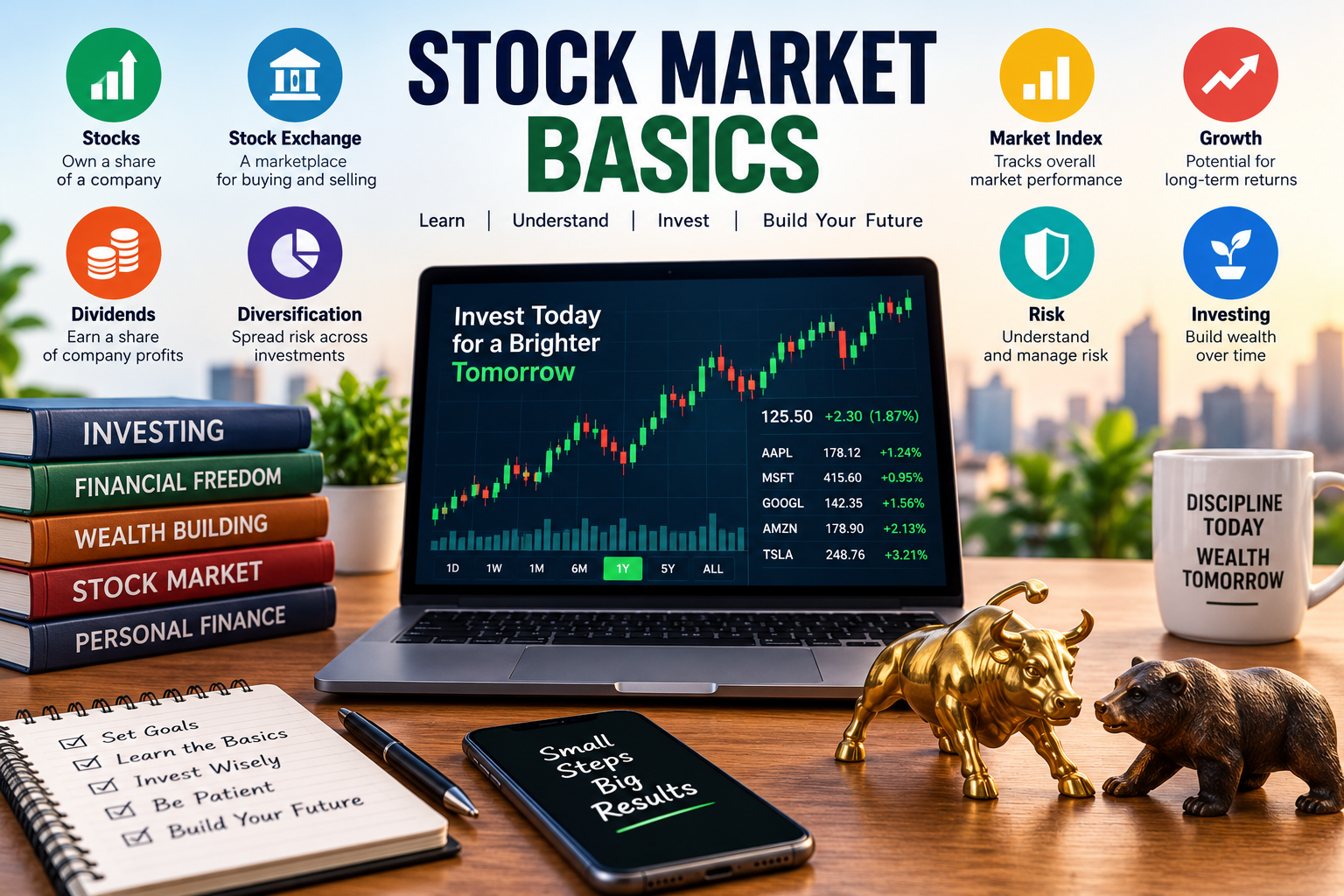
The stock market is one of the most important parts of the global financial system. It allows individuals and institutions to invest in businesses, build wealth over time, and participate in economic growth. However, for beginners, terms such as stocks, shares, dividends, market capitalization, and stock exchanges can make investing seem complicated.
Understanding stock market basics is the first step toward making informed financial decisions. You do not need to be a financial expert or have a large amount of money to start learning how investing works. What matters most is understanding the relationship between potential returns, investment risks, and long-term financial goals.
This beginner-friendly guide explains what the stock market is, how it operates, why stock prices change, different investment strategies, and common mistakes to avoid.

What Is the Stock Market?
The stock market is a financial marketplace where investors buy and sell shares of publicly traded companies. When you purchase a company’s stock, you acquire a small ownership interest in that business.
For example, if a company has issued one million shares and you own 100 shares, you own 0.01% of the company’s outstanding shares.
Your investment’s value may rise or fall depending on the company’s performance, economic conditions, and investor demand.
The stock market serves two major purposes: helping businesses raise capital and providing investors with opportunities to own shares in companies.
Stock Market Basics at a Glance
| Term | Simple Meaning |
|---|---|
| Stock | Ownership interest in a company |
| Share | A unit of company ownership |
| Stock Exchange | Marketplace where securities are traded |
| Investor | Someone who purchases assets expecting potential returns |
| Dividend | Distribution of company earnings or other funds to shareholders |
| Bull Market | Period of broadly rising market prices |
| Bear Market | Period of broadly declining market prices |
| Portfolio | Collection of investments |
| Market Capitalization | Total market value of a company’s outstanding shares |
| Stock Index | Measure tracking a selected group of stocks |
| Broker | Financial intermediary providing access to securities trading |
| ETF | Exchange-traded fund holding a portfolio of assets |
How Does the Stock Market Work?
The stock market connects buyers and sellers through organized exchanges and electronic trading systems.
Companies can initially sell shares to investors to raise money. After these shares become publicly traded, investors can buy and sell them through the secondary market.
Primary Market
The primary market is where newly issued securities are sold.
For example, when a private company offers shares to public investors for the first time through an Initial Public Offering (IPO), it enters the public securities market.
The money raised from newly issued shares generally goes to the issuing company, after applicable expenses.
Secondary Market
The secondary market is where investors trade existing shares with other investors.
Most everyday stock transactions take place in the secondary market.
When you purchase shares through a stockbroker, you generally buy them from another market participant rather than directly from the company.
The company does not usually receive money from these secondary-market transactions.
What Are Stocks and Shares?
Stocks represent ownership in a corporation. Shares are individual units of that ownership.
Suppose a company has 10,000 outstanding shares. If an investor owns 100 shares, they hold a 1% ownership interest in the company.
Shareholders may benefit if the business grows and the market assigns a higher value to its shares.
However, ownership does not guarantee profits. The stock price can decline, and investors may lose some or all of their investment.
Common Stocks
Common stocks are the most familiar type of company shares.
Common shareholders generally have voting rights and may receive dividends if the company’s board declares them.
Dividend payments are not guaranteed, and common shareholders have a lower claim on company assets than creditors and preferred shareholders during liquidation.
Preferred Stocks
Preferred stocks typically provide certain rights ahead of common shareholders, often involving dividends or claims on assets.
Some preferred shares pay fixed or formula-based dividends. Voting rights may be limited.
The exact features depend on the securities issued by the company.
What Are Stock Exchanges?
A stock exchange is an organized marketplace where eligible securities are bought and sold under established trading rules.
Exchanges help facilitate trading, price discovery, transparency, and market oversight.
Some well-known examples include:
- New York Stock Exchange (NYSE)
- Nasdaq Stock Market
- London Stock Exchange (LSE)
- Tokyo Stock Exchange (TSE)
- Pakistan Stock Exchange (PSX)
Each exchange operates under its own rules and applicable regulatory framework.
Investors generally access exchanges through brokerage firms rather than submitting orders directly to the exchange.
Why Do Stock Prices Go Up and Down?
Stock prices change because buyers and sellers continually reassess what a company is worth.
When demand for shares rises relative to available selling interest, prices tend to increase. When selling pressure is greater, prices tend to fall.
Several factors influence these changes.
Company Financial Performance
Revenue growth, profitability, cash flow, debt, and management decisions can affect investor expectations.
A company reporting stronger-than-expected earnings may attract buyers, although the share price can still decline if investors anticipated even better results.
Economic Conditions
Inflation, employment, economic growth, and consumer spending influence business performance and investor sentiment.
Economic slowdowns can affect corporate profits and increase uncertainty.
Interest Rates
Changes in interest rates influence borrowing costs and the relative attractiveness of investments.
Higher rates can pressure valuations for some stocks, although the effect varies across companies and economic conditions.
Market News and Investor Sentiment
Political developments, industry trends, product announcements, regulatory changes, and unexpected events may cause rapid price movements.
Short-term price movements do not always reflect changes in a company’s long-term value.
Understanding Bull Markets and Bear Markets
Bull and bear markets describe broad market trends.
Bull Market
A bull market is a period characterized by generally rising stock prices and improving market sentiment.
Investors may become more optimistic about corporate earnings and economic growth.
Bear Market
A bear market is commonly defined as a decline of at least 20% from a recent market high in a broad market index.
Bear markets are often associated with economic uncertainty, weakening earnings expectations, or negative investor sentiment.
Bull Market vs. Bear Market
| Feature | Bull Market | Bear Market |
|---|---|---|
| Price Direction | Generally rising | Generally falling |
| Investor Sentiment | Often optimistic | Often pessimistic |
| Market Confidence | Typically stronger | Typically weaker |
| Common Behavior | Increased buying interest | Greater risk aversion |
| Investment Risk | Still present | Potentially heightened |
Both types of markets are normal features of long-term investing.
How Do Investors Make Money From Stocks?
Stock investors generally seek returns through capital appreciation and dividends.
Capital Gains
A capital gain occurs when an investor sells an investment for more than its purchase price, excluding fees and taxes in this simplified example.
Suppose you buy 10 shares at $50 each.
Your total investment is $500.
If the price rises to $65 and you sell all 10 shares, the proceeds are $650.
Your capital gain is $150 before trading fees and taxes.
However, if the share price falls to $40 and you sell, you would experience a $100 capital loss.
Dividend Income
Some companies distribute a portion of their earnings or other available funds to shareholders as dividends.
For example, if a company pays an annual dividend of $2 per share and you own 50 shares, you would receive $100 in annual dividends, assuming the payment is maintained and you remain eligible.
Not every company pays dividends, and dividend amounts can be reduced or discontinued.
Total Return
Total return combines investment price changes and distributions, such as dividends.
A proper return calculation may also account for reinvested dividends, transaction costs, and taxes, depending on its purpose.
How to Start Investing in the Stock Market for Beginners
Starting stock market investing requires preparation, realistic expectations, and a basic understanding of financial risk.
1. Set Your Financial Goals
Before investing, determine why you want to invest.
Common financial goals include retirement savings, long-term wealth accumulation, children’s education, or purchasing a home.
Your investment goals help determine how much risk you can reasonably accept and when you may need your money.
2. Build an Emergency Fund
Before investing money you might need soon, consider maintaining accessible savings for unexpected expenses.
An emergency fund can help you avoid selling investments during unfavorable market conditions.
3. Choose a Regulated Stockbroker
A stockbroker provides the account and trading platform through which investors can buy and sell securities.
When choosing a brokerage, evaluate its regulatory status, trading fees, account requirements, available investments, customer support, and security features.
Choose a broker authorized to operate in your jurisdiction.
4. Open and Fund Your Investment Account
Account-opening requirements vary depending on your location and brokerage firm.
You may need to provide identification, financial information, tax details, and banking information.
After approval, you can deposit funds using a supported payment method.
5. Research Investments Before Buying
Investigate what a company does, how it earns revenue, its financial condition, and the risks affecting its business.
Read financial statements and assess whether the share price appears reasonable relative to the company’s fundamentals.
6. Start With an Affordable Amount
Only invest money you can afford to expose to market risk.
Some brokerage platforms support fractional shares, allowing investors to buy part of a share rather than a whole share.
Availability depends on the broker and securities involved.
7. Monitor and Review Your Portfolio
Review your investments periodically to ensure they remain appropriate for your financial goals.
Avoid making decisions solely because of daily price fluctuations.
Understanding Stock Market Orders
When buying or selling stocks, investors must understand how different order types operate.
| Order Type | How It Works | Main Consideration |
|---|---|---|
| Market Order | Seeks immediate execution at available market prices | Execution price is not guaranteed |
| Limit Order | Executes at a specified price or better | Execution is not guaranteed |
| Stop Order | Activates when the stop price is reached | Execution price may differ from stop price |
| Stop-Limit Order | Activates a limit order after a stop price is reached | May remain unexecuted |
Market Orders
A market order instructs a broker to buy or sell a security at the best available market price.
It generally prioritizes execution rather than obtaining a specific price.
Limit Orders
A limit order specifies the maximum price an investor is willing to pay or the minimum price they are willing to accept.
For example, a buy limit order at $25 will execute only at $25 or lower, provided sufficient selling interest is available.
This provides price control but does not guarantee that the trade will take place.
What Are Stock Market Indexes?
A stock market index tracks the performance of a selected group of securities.
Indexes help investors understand broader market trends and compare investment results against benchmarks.
Popular Stock Market Indexes
| Index | What It Tracks |
|---|---|
| S&P 500 | Approximately 500 leading large U.S. companies |
| Dow Jones Industrial Average | 30 major U.S. companies |
| Nasdaq Composite | Thousands of stocks listed on Nasdaq |
| FTSE 100 | 100 large companies listed on the London Stock Exchange |
| Nikkei 225 | 225 prominent Japanese stocks |
| KSE-100 | 100 selected companies on the Pakistan Stock Exchange |
An index’s performance does not necessarily reflect the performance of every company or sector in the market.
What Are ETFs and Mutual Funds?
Beginners do not necessarily need to select individual company stocks. Investment funds offer another way to participate in financial markets.
Exchange-Traded Funds (ETFs)
An ETF is an investment fund whose shares trade on exchanges.
ETFs may track stock indexes, industries, bonds, commodities, or other investment strategies.
A broad-market ETF can provide exposure to numerous companies through a single investment.
However, ETFs can still lose value, and specialized ETFs may be highly concentrated.
Mutual Funds
A mutual fund pools money from multiple investors to purchase a portfolio of securities.
Unlike conventional ETFs, traditional mutual fund shares are generally priced once per trading day based on their net asset value.
Some mutual funds follow stock indexes, while others are actively managed.
ETFs vs. Mutual Funds
| Feature | ETFs | Mutual Funds |
|---|---|---|
| Trading | During exchange trading hours | Generally once daily |
| Pricing | Market price | Net asset value |
| Management | Active or passive | Active or passive |
| Diversification | Depends on holdings | Depends on holdings |
| Costs | Vary by fund and broker | Vary by fund and share class |
Both investment types can be useful, but investors should examine underlying holdings, fees, risks, and objectives before purchasing.
Understanding Stock Market Risk
All stock market investments involve uncertainty.
Market Risk
Market risk refers to losses caused by movements in the overall financial market.
Even financially strong companies can experience falling share prices during broad market downturns.
Company-Specific Risk
Individual companies face risks such as declining sales, rising costs, lawsuits, poor management decisions, and increased competition.
Liquidity Risk
Liquidity risk arises when investors cannot easily buy or sell an asset at a reasonable price.
Thinly traded securities may have larger differences between buying and selling prices.
Inflation Risk
Inflation reduces the purchasing power of money.
Investment returns must be evaluated in relation to inflation to understand their real purchasing-power impact.
Currency Risk
International investments may be affected by exchange-rate fluctuations.
A foreign investment can rise in its local currency while providing a smaller return, or even a loss, when converted into the investor’s home currency.
What Is Portfolio Diversification?
Diversification means distributing investments among different assets, companies, industries, or markets.
Its purpose is to reduce dependence on the performance of a single investment.
For example, an investor holding shares in only one technology company faces substantial company-specific risk.
An investor holding a diversified collection of stocks and bonds may be less exposed to the failure of one business.
However, diversification does not eliminate market risk or guarantee protection against losses.
Diversification vs. Asset Allocation
Diversification involves spreading investments within and across categories.
Asset allocation determines how much of a portfolio is invested in major asset classes, such as stocks, bonds, and cash.
The appropriate allocation depends on financial goals, investment time horizon, and risk tolerance.
Long-Term Investing vs. Short-Term Trading
Long-term investing and short-term trading involve different approaches to financial markets.
| Feature | Long-Term Investing | Short-Term Trading |
|---|---|---|
| Holding Period | Years or decades | Minutes, days, or weeks |
| Primary Focus | Business value and long-term growth | Short-term price movement |
| Trading Frequency | Usually lower | Usually higher |
| Transaction Costs | Often lower due to fewer trades | May accumulate quickly |
| Time Commitment | Periodic monitoring | Often frequent monitoring |
| Main Risks | Market declines and business performance | Volatility, execution risk, leverage |
Long-Term Investing
Long-term investors generally purchase assets with the intention of holding them for extended periods.
They may focus on company fundamentals, sustainable earnings, valuation, and diversified investment funds.
A longer holding period can provide more time to recover from temporary market declines, although recovery is never guaranteed.
Short-Term Trading
Short-term traders attempt to profit from price changes over relatively brief periods.
They may use technical analysis, market trends, and trading strategies.
Frequent trading can create significant costs, emotional pressure, and financial risks.
Beginners should be especially cautious about margin trading and leveraged products because losses can accumulate rapidly.
Important Stock Market Terms Every Beginner Should Know
Market Capitalization
Market capitalization measures a company’s total equity market value.
The basic formula is:
Market Capitalization = Share Price × Outstanding Shares
For example, a company with 10 million outstanding shares trading at $20 per share has a market capitalization of $200 million.
Price-to-Earnings Ratio
The price-to-earnings ratio, or P/E ratio, compares a company’s share price with its earnings per share.
P/E Ratio = Share Price ÷ Earnings Per Share
A company trading at $100 per share with annual earnings of $5 per share has a P/E ratio of 20.
The P/E ratio can help investors compare valuations, but it should not be used alone.
Dividend Yield
Dividend yield measures annual dividend payments relative to the current share price.
Dividend Yield = Annual Dividend Per Share ÷ Share Price × 100
If a company pays $3 annually per share and its stock price is $60, its dividend yield is 5%.
A high dividend yield does not automatically indicate a good investment. It may also result from a significant decline in the share price.
Volatility
Volatility describes how significantly an asset’s price fluctuates over time.
Highly volatile stocks may experience rapid price changes in either direction.
Trading Volume
Trading volume measures the number of shares traded during a specific period.
It can help investors evaluate trading activity and market liquidity.
Common Stock Market Mistakes Beginners Should Avoid
Investing Without Research
Buying stocks based entirely on rumors, advertisements, or social media recommendations can expose investors to unnecessary risks.
Always understand what you are buying and why.
Putting All Your Money Into One Stock
Concentrating investments in a single company increases exposure to company-specific losses.
Diversification can help manage this risk.
Trying to Predict Every Market Movement
Consistently predicting short-term price movements is extremely difficult.
Instead of relying on predictions, investors can develop strategies based on financial objectives and risk tolerance.
Making Emotional Decisions
Fear and excitement can lead investors to buy after large price increases or sell after significant declines.
A written investment plan can support more consistent decisions.
Ignoring Fees and Taxes
Brokerage commissions, fund expenses, currency conversion fees, and taxes can reduce investment returns.
Understand the full cost of investing before opening positions.
Falling for Investment Scams
Be cautious of promises of guaranteed high returns, secret trading systems, or pressure to transfer money immediately.
Legitimate stock investments involve risk, and no investment strategy can guarantee consistent profits.
Stock Market Investing Tips for Beginners
Successful investing begins with sound financial habits rather than complicated trading strategies.
- Invest with clear goals: Understand when and why you will need your money.
- Learn before purchasing: Research securities, funds, costs, and potential risks.
- Consider diversification: Avoid depending entirely on one company or sector.
- Manage your risk: Select investments appropriate for your financial circumstances.
- Think long term when appropriate: Avoid allowing everyday market movements to control your decisions.
- Keep learning: Improve your understanding of financial statements, markets, and investment products.
Investors should also distinguish between money intended for short-term expenses and funds available for longer-term investment.
Frequently Asked Questions About Stock Market Basics
Can Beginners Invest in the Stock Market?
Yes. Beginners can invest through regulated brokerage firms and investment funds. It is important to understand investment risks, account requirements, and costs before making a purchase.
How Much Money Do You Need to Start Investing in Stocks?
The minimum amount depends on the brokerage, account type, and investment. Some platforms offer fractional shares, allowing investors to start with relatively small amounts. Others require whole-share purchases or minimum deposits.
Is the Stock Market Safe for Beginners?
The stock market is regulated in many jurisdictions, but investment losses remain possible. Regulation does not guarantee investment performance or prevent all fraud. Beginners should use authorized brokers and understand the products they purchase.
Can You Lose All Your Money in Stocks?
Yes. An individual stock can become worthless if the company fails. Diversified funds can also experience significant losses, although they generally reduce dependence on any single company’s performance.
What Is the Difference Between Stocks and Shares?
Stock refers broadly to ownership in a corporation, while a share represents an individual unit of ownership. In everyday financial discussions, the terms are often used interchangeably.
Are Stocks Better Than Savings Accounts?
Stocks generally offer greater long-term growth potential but involve market risk. Savings accounts usually provide greater stability and accessibility, subject to applicable bank protections and terms. The appropriate choice depends on the purpose and timing of the funds.
What Is the Best Age to Start Investing?
There is no universal best age. Starting earlier can provide more time for compounding, but financial readiness, legal account eligibility, emergency savings, and investment knowledge are important considerations.
What Is Dollar-Cost Averaging?
Dollar-cost averaging is the practice of investing a fixed amount of money at regular intervals regardless of market conditions.
It can encourage consistent investing and reduce the temptation to time the market, but it does not guarantee profits or prevent losses.
Can You Make Money From Stocks Without Selling Them?
Some stocks pay dividends, allowing eligible shareholders to receive income while continuing to hold their shares. Dividend payments are not guaranteed and may change.
Is Stock Trading the Same as Investing?
Not exactly. Trading often focuses on shorter-term price fluctuations, while investing generally focuses on holding assets to pursue longer-term financial objectives.
Conclusion
Understanding stock market basics is an important first step toward becoming a more informed investor. Stocks represent ownership in companies, stock exchanges facilitate trading, and market prices change in response to business performance, economic conditions, and investor expectations.
Beginners should develop a clear understanding of investment products, market orders, diversification, financial risk, and portfolio management before committing substantial capital.
Although the stock market offers opportunities for long-term wealth creation, returns are never guaranteed, and losses are possible.
A disciplined approach built around research, realistic goals, risk management, and continuous learning can help beginners make more thoughtful investment decisions.
Disclaimer: This article provides general educational information and does not constitute personalized financial, investment, or tax advice. Investment regulations, fees, and tax treatment vary by country and individual circumstances.
Is this conversation helpful so far?