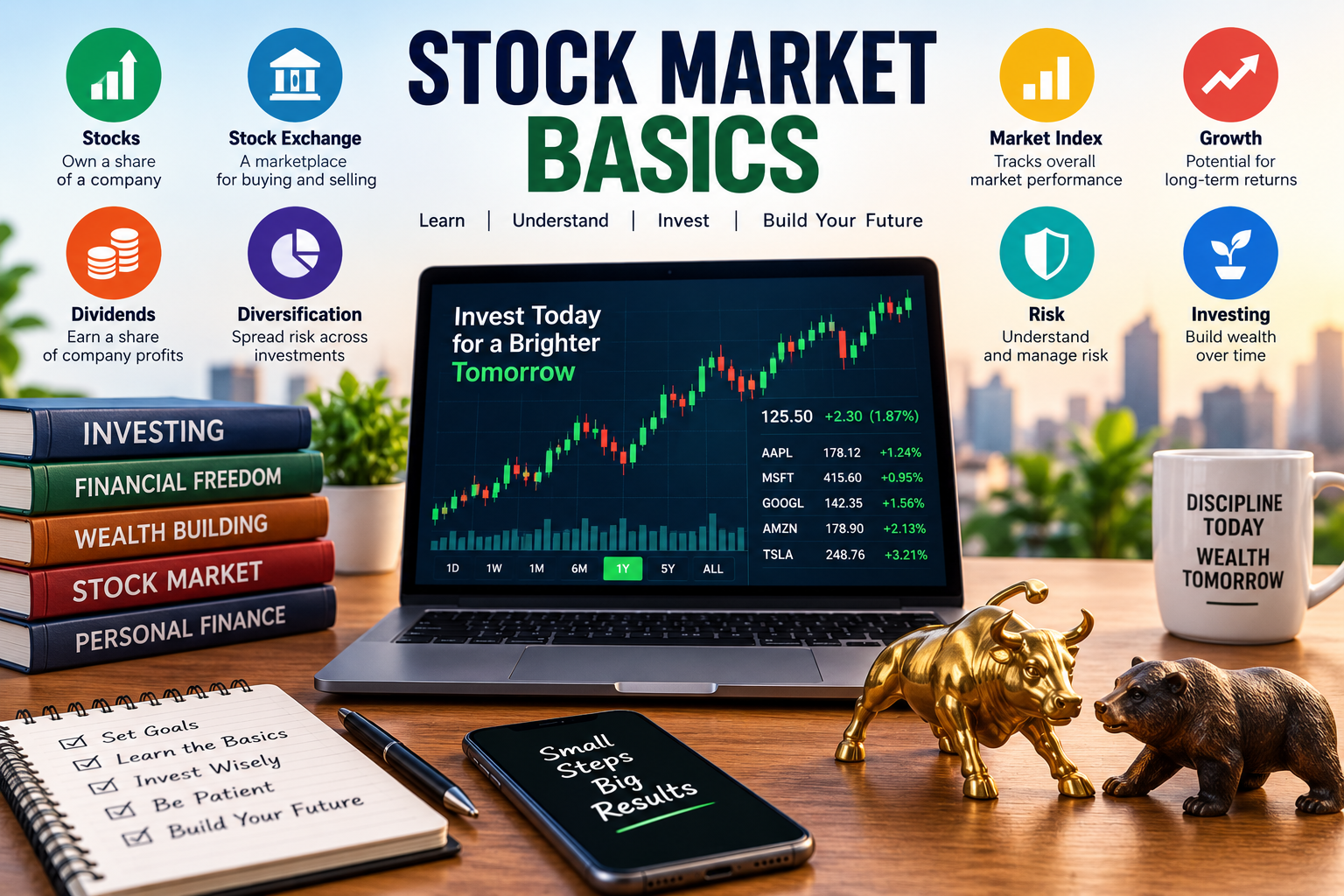
Understanding stock market basics is one of the most valuable financial skills anyone can develop. Whether you want to build long-term wealth, save for retirement, or simply understand how companies and investors make money, learning how the stock market works is an excellent starting point.
The stock market may appear complicated because of constantly changing prices, unfamiliar terminology, and financial news. However, its fundamental concepts are surprisingly straightforward. Investors buy shares representing ownership in businesses, and the value of those shares changes based on company performance, investor expectations, economic conditions, and market demand.
For beginners, successful investing is not about predicting every market movement or discovering the next overnight success. It is about understanding risk, choosing suitable investments, making informed decisions, and remaining consistent over time.

This comprehensive guide explains how the stock market operates, what stocks and shares mean, how investors earn returns, the different types of investments, common beginner mistakes, and essential principles for developing a responsible investment strategy in 2026.
What Is the Stock Market?
The stock market is a financial marketplace where investors buy and sell shares of publicly traded companies. These shares represent partial ownership in businesses that have made their stock available to investors.
When a company becomes publicly traded, eligible investors can purchase its shares through stock exchanges and brokerage platforms.
For example, if you purchase stock in a company, you become a shareholder. Your ownership percentage depends on how many shares you own relative to the company’s total outstanding shares.
Shareholders may benefit when a company’s stock increases in value or when the business distributes profits through dividends. However, share prices can also decline, and investors can lose money.
The stock market serves two important purposes: it allows companies to raise capital through issuing securities, and it provides investors with opportunities to buy and sell ownership interests.
How Does the Stock Market Work?
The stock market operates through a network of exchanges, brokerage firms, investors, and financial institutions.
When investors want to purchase or sell shares, they typically place orders through brokerage accounts. These orders are routed to trading venues where transactions can take place.
Understanding Buyers and Sellers
Stock prices are influenced by the interaction between buyers and sellers.
If more investors are willing to purchase shares at higher prices, the stock price may rise. Conversely, if sellers are willing to accept lower prices, the stock price may fall.
Market prices also respond to factors such as earnings reports, interest rates, industry developments, regulatory changes, and expectations about future business performance.
What Happens When You Buy a Stock?
Imagine a publicly traded company called ABC Technologies.
You decide to purchase 10 shares at $50 each, making your total investment $500 before transaction fees.
If the price increases to $60 per share, your investment is worth $600. Your unrealized gain would be $100.
If the stock declines to $40 per share, your investment would be worth $400, representing an unrealized loss of $100.
These gains and losses remain unrealized until the shares are sold, although their current market value affects your investment portfolio.
What Are Stocks and Shares?
Stocks represent ownership interests in corporations. A share is an individual unit of that ownership.
Although people frequently use the words stock and share interchangeably, there is a slight distinction.
The term stock generally refers to equity ownership in one or more companies, while a share refers to a specific unit of ownership.
Common Stocks
Common stocks typically give shareholders an ownership interest and may provide voting rights on certain corporate matters.
Common shareholders may receive dividends, but dividends are not guaranteed.
If a company is liquidated, common shareholders generally have a lower claim on remaining assets than creditors and preferred shareholders.
Preferred Stocks
Preferred stocks often provide greater priority over common stocks for dividend payments and certain liquidation distributions.
Some preferred shares pay fixed or formula-based dividends, although their exact rights depend on the issuing company.
Preferred shareholders commonly have limited or no voting rights. Preferred stock may behave differently from ordinary shares, especially when market interest rates change.
Why Do Companies Issue Stocks?
Companies issue stock to raise money for business activities.
A business may require capital to expand its operations, develop new products, hire employees, acquire equipment, or enter new markets.
Instead of borrowing all the necessary funds, the company can issue equity and sell an ownership stake to investors.
Initial Public Offering (IPO)
An Initial Public Offering occurs when a company first offers its shares to the public through a registered or otherwise legally permitted offering.
The IPO process typically involves financial disclosures, regulatory requirements, underwriting arrangements, and determining an offering price.
After shares begin public trading, investors can generally buy and sell them in the secondary market.
Primary Market vs Secondary Market
| Feature | Primary Market | Secondary Market |
|---|---|---|
| Purpose | Issuing new securities | Trading existing securities |
| Participants | Issuer and investors | Investors and trading intermediaries |
| Funds Received By | Generally the issuer | Generally the selling investor |
| Example | Newly issued IPO shares | Stock exchange trades |
| Main Function | Capital formation | Liquidity and price discovery |
Understanding this distinction helps beginners recognize that purchasing shares on an exchange usually does not transfer that purchase price directly to the issuing company.
What Is a Stock Exchange?
A stock exchange is an organized marketplace where eligible securities are traded under defined rules and regulatory requirements.
Stock exchanges support orderly trading, price discovery, transparency, and market oversight.
Several exchanges play major roles in global financial markets.
New York Stock Exchange (NYSE)
The New York Stock Exchange is one of the world’s best-known stock exchanges. It lists many large, established companies across different industries.
Nasdaq
Nasdaq is an electronic securities exchange associated with numerous technology, healthcare, and growth-oriented companies, although it includes businesses from many sectors.
London Stock Exchange (LSE)
The London Stock Exchange is an important financial marketplace for UK and international securities.
Pakistan Stock Exchange (PSX)
The Pakistan Stock Exchange provides a regulated marketplace for eligible securities in Pakistan, including shares of listed Pakistani companies.
Investors commonly access stock exchanges through licensed brokerage firms rather than placing orders directly with an exchange.
What Are Stock Market Indexes?
A stock market index measures the performance of a selected group of securities according to a defined methodology.
Indexes help investors understand how particular markets, industries, or groups of companies are performing.
S&P 500
The S&P 500 tracks approximately 500 leading publicly traded US companies. It is widely used as a benchmark for the US large-cap equity market.
Dow Jones Industrial Average
The Dow Jones Industrial Average follows 30 prominent US companies and uses a price-weighted calculation method.
Nasdaq Composite
The Nasdaq Composite measures the performance of thousands of securities listed on Nasdaq and has substantial technology-sector exposure.
KSE-100 Index
The KSE-100 Index is a major benchmark for Pakistan’s equity market.
Stock indexes do not represent the performance of every listed company. Their results depend on constituent selection, weighting methods, and index rules.
Different Types of Stocks Beginners Should Know
Not all stocks offer the same opportunities or carry the same risks. Investors often classify shares based on company size, growth expectations, dividend policies, and business characteristics.
Growth Stocks
Growth stocks belong to companies expected to increase their revenue or earnings faster than the broader market.
These businesses may reinvest their profits into expansion rather than distributing substantial dividends. Growth stocks can offer appreciation potential, but high expectations can also make their prices volatile.
Value Stocks
Value stocks are shares that investors believe trade below their underlying business value.
Value investors examine financial statements, earnings, assets, debt, and future profitability to identify potentially undervalued companies.
However, a stock trading at a low valuation is not automatically a bargain. Its price may reflect genuine business difficulties.
Dividend Stocks
Dividend stocks are issued by companies that distribute some of their profits or available capital to shareholders.
They appeal to investors seeking investment income, although dividend payments can be reduced or discontinued.
Blue-Chip Stocks
Blue-chip stocks generally represent established companies with substantial market presence and long operating histories.
These businesses may have recognizable brands and relatively stable operations, but they are not immune to financial losses or declining stock prices.
Small-Cap and Large-Cap Stocks
Market capitalization measures a company’s total equity market value.
It is calculated using the following formula:
Market Capitalization = Share Price × Outstanding Shares
Large-cap companies generally have higher market valuations and established operations. Small-cap companies are smaller businesses that may offer growth potential alongside greater financial and market risks.
How Do Investors Make Money in the Stock Market?
There are two primary ways stock investors may earn returns: capital appreciation and dividends.
Capital Gains
A capital gain occurs when an investment is sold for more than its purchase price, after considering relevant transaction costs.
For example, suppose you purchase 20 shares at $25 each.
Your initial investment is $500. If you later sell all 20 shares at $35 each, you receive $700 before fees and taxes, resulting in a $200 capital gain.
Capital gains are not guaranteed because share prices fluctuate.
Dividend Income
Dividends are distributions made by companies to eligible shareholders.
For example, owning 100 shares of a company paying an annual dividend of $2 per share would produce $200 in gross annual dividend income, assuming the dividend remains unchanged and you remain eligible.
Investors should examine dividend sustainability rather than choosing companies solely because they advertise unusually high dividend yields.
The Power of Compounding
Compounding occurs when investment returns generate additional returns over time.
For example, consider a hypothetical $1,000 investment earning a constant 7% annual return, reinvested without additional contributions.
Hypothetical Growth of $1,000
Assumes 7% annual compounding, with no fees or taxes. Not a forecast.
$0$1.5K$3K$4.5KYear 0Year 5Year 10Year 15Year 20
The example illustrates compounding, not a guaranteed stock market return. Actual investment performance varies, sometimes significantly, from year to year.

Investor
Understanding Bull Markets and Bear Markets
Financial news frequently uses the terms bull market and bear market to describe broader market trends.
Bull Market
A bull market is a sustained period of generally rising market prices and positive investor sentiment.
Economic expansion, strong corporate earnings, and improving expectations can contribute to bullish market conditions.
Bear Market
A bear market generally refers to a sustained decline of approximately 20% or more from a recent market high in a major market index.
Bear markets may occur during recessions, financial crises, economic uncertainty, or changing investor expectations.
Bull Market vs Bear Market
| Feature | Bull Market | Bear Market |
|---|---|---|
| General Direction | Rising prices | Falling prices |
| Investor Sentiment | Often optimistic | Often pessimistic |
| Economic Conditions | Frequently improving | May be weakening |
| Investment Risks | Overvaluation and corrections | Further losses and volatility |
| Typical Behavior | Increased buying interest | Greater selling pressure |
Neither type of market continues indefinitely, and identifying turning points in advance is extremely difficult.
What Are ETFs and Mutual Funds?
Beginners do not have to purchase individual company shares to participate in the stock market.
Mutual funds and exchange-traded funds allow investors to gain exposure to collections of securities through a single investment.
Exchange-Traded Funds (ETFs)
An ETF is an investment fund whose shares trade on an exchange.
Some ETFs track broad market indexes, while others focus on particular sectors, investment strategies, or asset classes.
A diversified stock index ETF may hold hundreds or thousands of different company shares.
Mutual Funds
Mutual funds pool money from investors and invest according to a defined strategy.
They may be actively managed by investment professionals or passively managed to follow an index.
ETFs vs Mutual Funds
| Feature | ETFs | Mutual Funds |
|---|---|---|
| Trading | Usually throughout market hours | Usually priced once per trading day |
| Management | Active or passive | Active or passive |
| Diversification | Depends on underlying holdings | Depends on underlying holdings |
| Investment Minimum | Often one share or fractional share where supported | Depends on fund |
| Expenses | Vary by fund | Vary by fund |
Both fund types can support diversification, but a narrowly focused fund may still carry substantial concentration risk.
Investor
How to Start Investing in the Stock Market as a Beginner
Developing an investment approach involves understanding your finances, selecting appropriate accounts, researching investments, and managing risk.
1. Define Your Financial Goals
Determine why you want to invest.
Some investors focus on retirement, while others aim to fund education, build long-term savings, or achieve future financial independence.
Your goal influences the amount of risk you can reasonably accept and how long you can keep your money invested.
2. Build an Emergency Fund
Before investing money you may need soon, consider setting aside accessible cash for unexpected expenses.
An emergency reserve can reduce the possibility of being forced to sell shares during a market decline.
3. Choose a Regulated Brokerage Firm
A brokerage account allows investors to purchase, hold, and sell securities.
When comparing brokers, examine regulatory authorization, account fees, trading commissions, available investments, customer support, and security measures.
Different countries have distinct investor-protection rules and tax requirements.
4. Understand Your Risk Tolerance
Risk tolerance describes your willingness and financial ability to experience investment losses.
An investor saving for a short-term goal may need a more conservative allocation than someone investing for several decades.
5. Research Before Buying
Investors should understand what a company does, how it generates revenue, whether its earnings are sustainable, and what risks could affect its performance.
Financial statements, official regulatory disclosures, and company reports can provide useful information.
6. Start With an Affordable Amount
There is no universal minimum investment amount.
Some brokerage platforms permit fractional-share investing, while others require whole-share purchases or account minimums.
Starting with an amount you can afford to keep invested allows you to learn without taking unnecessary financial risks.
7. Review Your Investments Periodically
Monitoring an investment portfolio helps ensure that its holdings continue to match your financial goals and risk tolerance.
However, repeatedly reacting to daily price fluctuations can lead to emotional decisions and excessive trading.
Understanding Stock Market Orders
When purchasing or selling stocks through a brokerage account, investors can choose different order types.
Market Orders
A market order instructs a broker to buy or sell a security promptly at the best available price.
The execution price is not guaranteed, especially in volatile or less liquid markets.
Limit Orders
A limit order specifies the maximum price a buyer is willing to pay or the minimum price a seller is willing to accept.
For example, a buy limit order set at $40 should execute only at $40 or lower, but it may never execute.
Stop-Loss Orders
A stop-loss order is designed to trigger a sale when a security reaches a predetermined price.
A conventional stop order becomes a market order when triggered, meaning the actual execution price could be significantly different from the stop price.
These distinctions are important because order types affect execution certainty and price control.
Investor
+1
Stock Market Terms Every Beginner Should Understand
The following terms frequently appear in financial reports, trading platforms, and investment discussions.
| Term | Meaning |
|---|---|
| Shareholder | An investor who owns company shares |
| Portfolio | A collection of investments |
| Dividend | A distribution paid to eligible shareholders |
| Market Cap | Total market value of outstanding equity shares |
| Volatility | Degree of price fluctuation |
| Liquidity | Ease of buying or selling an asset |
| P/E Ratio | Share price divided by earnings per share |
| EPS | Earnings attributable to each common share |
| IPO | Initial Public Offering |
| ETF | Exchange-Traded Fund |
| Capital Gain | Profit resulting from selling an asset above its cost |
| Diversification | Spreading investments to reduce concentration |
| Broker | An intermediary facilitating securities transactions |
| Bid Price | Price a buyer is offering |
| Ask Price | Price a seller is requesting |
Learning this terminology makes financial information easier to interpret.
How to Analyze a Stock Before Investing
Evaluating a company’s business and financial position can help investors make more informed decisions.
Revenue and Earnings
Revenue represents income generated through business activities, while net income reflects profit after relevant expenses.
Consistent revenue growth can be encouraging, but investors should also examine profitability and the costs required to generate that growth.
Price-to-Earnings Ratio
The P/E ratio compares a company’s share price with its earnings per share.
P/E Ratio = Share Price ÷ Earnings Per Share
For example, a company trading at $100 per share with annual earnings of $5 per share has a P/E ratio of 20.
This ratio can help compare valuations, but differences in growth expectations, industry characteristics, and earnings quality matter.
Debt and Financial Stability
Excessive borrowing can create financial pressure, particularly when interest rates increase or business revenue weakens.
Investors often examine debt levels, interest coverage, cash flow, and liquidity when assessing financial stability.
Competitive Position
A business with durable customer relationships, valuable intellectual property, efficient operations, or other sustainable advantages may be better positioned to compete.
However, even financially strong businesses can become poor investments if their shares are purchased at excessively high valuations.
Common Stock Market Risks
Stock investing carries risks that should be understood before committing money.
Market Risk
Broad market declines can reduce the value of many investments simultaneously, regardless of the strength of individual businesses.
Company-Specific Risk
Poor management decisions, declining customer demand, lawsuits, debt problems, or unsuccessful products can negatively affect individual stocks.
Liquidity Risk
Some securities trade infrequently, making them difficult to sell quickly without accepting an unfavorable price.
Inflation Risk
Even when investments generate positive nominal returns, inflation can reduce the purchasing power of those gains.
Currency Risk
Investing in foreign markets creates exposure to changing exchange rates. Currency movements can increase or reduce returns when converted into an investor’s home currency.
Interest Rate Risk
Changes in interest rates may influence corporate borrowing costs, investment valuations, and the relative attractiveness of different asset classes.
Why Diversification Matters in Stock Market Investing
Diversification means distributing investments across different assets, companies, sectors, or regions instead of concentrating all available capital in one position.
For example, someone investing exclusively in technology companies may be heavily exposed to developments affecting that industry.
A more diversified portfolio may include investments spanning multiple sectors and asset categories.
Diversification cannot eliminate market risk or guarantee a profit, but it can help reduce the impact of poor performance from a single holding.
Investor
Stock Market Investing vs Trading
Investing and trading both involve buying and selling securities, but their objectives and typical holding periods differ.
| Feature | Investing | Trading |
|---|---|---|
| Holding Period | Often years or decades | Can range from minutes to months |
| Main Focus | Long-term investment outcomes | Shorter-term price movements |
| Research Approach | Often fundamentals and valuation | Often price behavior and market conditions |
| Transaction Frequency | Usually lower | Often higher |
| Costs | Can be relatively low | Frequent transactions may increase costs |
| Main Challenges | Market declines and patience | Timing, volatility, and execution |
Neither approach guarantees profits. Short-term trading can involve substantial losses, particularly when leverage or borrowed money is used.
For most beginners, understanding long-term investing fundamentals before considering complex trading strategies is a sensible approach.
Common Stock Market Mistakes Beginners Should Avoid
New investors sometimes lose money because they make decisions based on excitement, fear, or incomplete information.
Investing Without Research
Buying a stock solely because it is popular on social media can expose investors to poorly understood risks.
Following Market Hype
Rapid price increases do not necessarily indicate that a company is financially strong or reasonably valued.
Putting All Money Into One Stock
Concentrating investments in a single company exposes a portfolio to substantial company-specific risk.
Trying to Predict Every Market Movement
Consistently identifying market highs and lows is extremely difficult, even for experienced investors.
Ignoring Fees and Taxes
Brokerage commissions, fund expenses, currency-conversion charges, and taxes can meaningfully affect net investment returns.
Using Borrowed Money Without Understanding the Risk
Leverage magnifies gains and losses. Borrowing to invest can create financial obligations even after the purchased investments decline in value.
Making Emotional Decisions
Panic selling during market declines or buying aggressively because of fear of missing out can undermine an otherwise reasonable financial plan.
Stock Market Basics for Students and Young Investors
Students and young adults may benefit from learning investing principles early, even if they have limited money available.
Financial education helps individuals understand savings, inflation, risk, compound growth, and the role of investing in long-term financial planning.
Young investors can focus on learning how financial markets function, creating budgets, understanding investment products, and comparing risk levels.
They should also recognize that money needed for tuition, rent, and essential living expenses should not be exposed to unnecessary short-term market volatility.
Investment knowledge is a useful life skill regardless of whether someone decides to purchase shares immediately.
Frequently Asked Questions About Stock Market Basics
What Is the Stock Market in Simple Words?
The stock market is a marketplace where investors buy and sell shares representing ownership in publicly traded companies.
How Much Money Do You Need to Start Investing?
The minimum amount depends on the brokerage firm and investment product. Some platforms support fractional shares or small recurring investments, while others have minimum funding requirements.
Can Beginners Make Money in the Stock Market?
Yes, beginners can earn investment returns through capital gains and dividends. However, profits are not guaranteed, and they can lose some or all of their invested capital.
Is Stock Market Investing Safe?
Stocks carry market and company-specific risks. Diversification, suitable asset allocation, and careful research can help manage risk, but no stock investment is completely risk-free.
What Is the Difference Between Stocks and Shares?
Stock generally refers to equity ownership in companies, while a share represents an individual unit of that ownership.
What Causes Stock Prices to Rise and Fall?
Stock prices respond to buying and selling activity influenced by earnings, future business expectations, interest rates, economic conditions, financial news, and investor sentiment.
What Is the Best Way for Beginners to Learn Stock Investing?
Beginners can study foundational financial concepts, review reliable investor education resources, practice interpreting company financial statements, and learn about diversified investments before risking substantial capital.
Can You Lose More Money Than You Invest in Stocks?
When buying ordinary shares outright without borrowing, your maximum investment loss is generally the purchase amount and associated costs. Using margin, derivatives, or certain leveraged strategies can create losses exceeding the original capital committed.
Are ETFs Better Than Individual Stocks for Beginners?
Broadly diversified ETFs may provide a simpler way to obtain exposure to many companies, reducing individual-stock concentration. However, ETFs still involve risk, and not every ETF is diversified or appropriate for beginners.
How Long Should You Hold Stocks?
An appropriate holding period depends on financial goals, investment characteristics, and risk tolerance. Long-term investors commonly plan to hold diversified equity investments for many years, but no holding period guarantees positive returns.
Conclusion
Learning stock market basics provides a foundation for understanding how businesses raise capital, how investors participate in financial markets, and how investment returns and risks develop over time.
Beginners should focus on understanding stocks, exchanges, indexes, dividends, diversification, financial statements, and appropriate risk management before making major investment decisions.
The stock market offers opportunities for long-term wealth building, but success is never guaranteed. Careful research, realistic expectations, disciplined financial planning, and patience are more valuable than chasing quick profits.
Disclaimer: This article is for educational and informational purposes only and does not constitute personalized financial or investment advice. Investment values can fall as well as rise, and readers should consider their individual circumstances before investing.