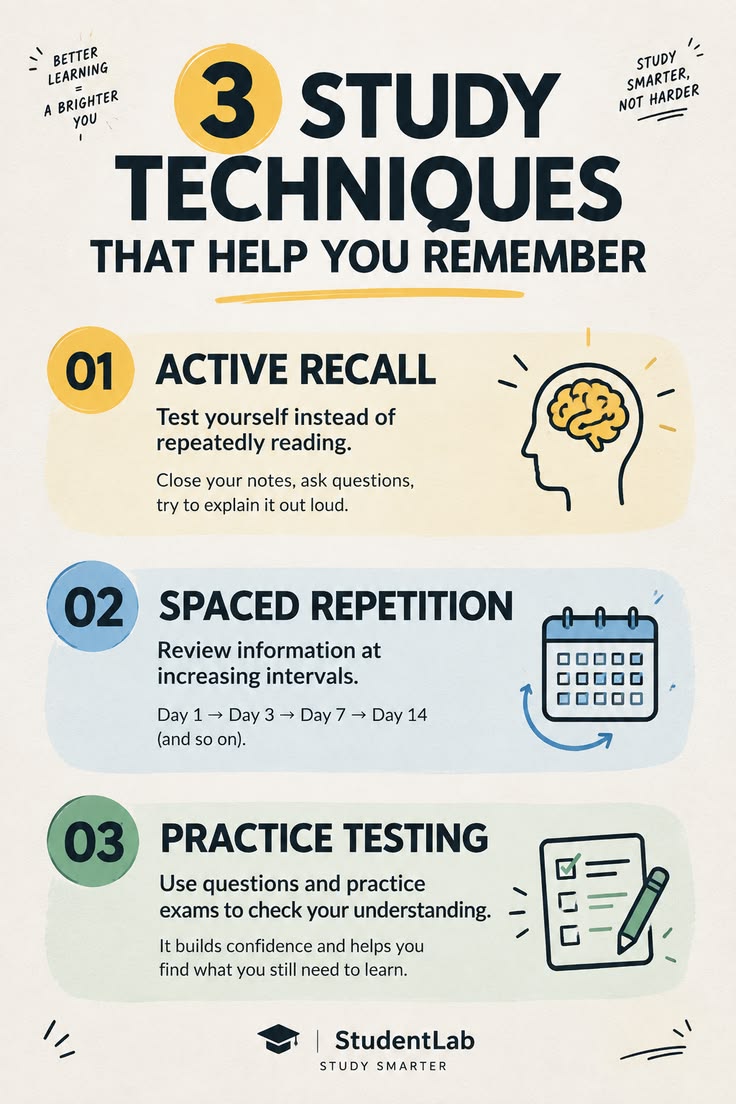
Studying effectively is not about spending endless hours reading textbooks or memorizing information. It is about using the right strategies to understand concepts, retain knowledge, and recall important information when needed. Whether you are a school student, university student, or preparing for competitive examinations, choosing the best study techniques can make learning easier and more productive.
Many students struggle because they rely on passive methods such as rereading notes, highlighting textbooks, or studying everything the night before an exam. Although these activities can feel productive, they are often less effective than techniques that require active thinking and regular practice.
The good news is that research in cognitive psychology has identified several approaches that can improve learning and long-term retention. This guide explores 15 effective study techniques, explains how they work, and shows how to incorporate them into your daily study routine.

What Are the Best Study Techniques?
The best study techniques include active recall, spaced repetition, practice testing, interleaving, self-explanation, and teaching concepts to others. These methods encourage students to retrieve information, strengthen understanding, and revisit material over time.
Instead of simply reading information repeatedly, effective studying involves actively working with what you have learned.
Best Study Techniques at a Glance
| Study Technique | Best For | Main Benefit |
|---|---|---|
| Active Recall | Almost all subjects | Strengthens memory retrieval |
| Spaced Repetition | Long-term learning | Reduces forgetting |
| Pomodoro Technique | Maintaining focus | Structures study sessions |
| Feynman Technique | Understanding concepts | Reveals knowledge gaps |
| Practice Testing | Exam preparation | Improves recall and application |
| Interleaving | Mathematics and problem-solving | Improves strategy selection |
| Mind Mapping | Connecting related ideas | Organizes information visually |
| SQ3R Method | Textbook reading | Encourages active comprehension |
| Blurting Method | Revision | Identifies forgotten material |
| Cornell Notes | Lectures and classes | Organizes notes for review |
| Dual Coding | Visual and verbal learning | Connects words with diagrams |
| Self-Explanation | Complex topics | Deepens understanding |
| Time Blocking | Study planning | Reduces scheduling confusion |
| Elaborative Interrogation | Theory-heavy subjects | Builds meaningful connections |
| Distributed Practice | Multiple subjects | Avoids last-minute cramming |
1. Active Recall: Test Yourself Instead of Rereading
Active recall is one of the most effective study techniques for improving memory. It involves retrieving information from your brain without looking at the answer.
When students repeatedly test themselves, they practice the mental process required during examinations.
How to Use Active Recall
- Read a short section of your textbook.
- Close the book and recall the main ideas.
- Write down everything you remember.
- Compare your answers with the original material.
- Review anything you missed.
- Repeat the exercise later.
For example, after studying the human digestive system, close your notes and try to explain the functions of the stomach, small intestine, and large intestine.
Why it works: Retrieving information strengthens access to that knowledge and exposes areas that require additional practice.
Active recall is particularly helpful for science, history, vocabulary, and fact-heavy subjects.
2. Spaced Repetition: Review Information Before You Forget It
Spaced repetition involves reviewing information at increasing intervals rather than studying the same material continuously.
This approach helps prevent forgetting and supports long-term retention.
How Spaced Repetition Works
After learning a new concept, review it multiple times over several days or weeks.
A sample revision schedule might look like this:
| Review Session | Suggested Timing |
|---|---|
| First Review | Same day |
| Second Review | 1 day later |
| Third Review | 3 days later |
| Fourth Review | 7 days later |
| Fifth Review | 14 days later |
| Sixth Review | 30 days later |
These are example intervals, not a universal formula. Difficult information may need more frequent review, while familiar material can be reviewed less often.
Flashcards are especially useful for spaced repetition because they allow students to review individual concepts based on how well they remember them.
Best for: Languages, medical terminology, scientific definitions, formulas, and historical facts.
3. Pomodoro Technique: Improve Focus With Structured Sessions
The Pomodoro Technique is a time-management method that divides studying into focused sessions separated by short breaks.
It can be particularly helpful for students who struggle with procrastination or find long study sessions overwhelming.
How to Follow the Pomodoro Technique
- Choose one specific study task.
- Set a timer for 25 minutes.
- Work without unnecessary interruptions.
- Take a 5-minute break.
- Repeat the process.
- After approximately four sessions, take a longer break of 15–30 minutes.
For example, you could spend one session solving mathematics problems, another reviewing biology, and a third practicing English grammar.
The 25-minute interval is flexible. Some students prefer 40 or 50 minutes of focused work followed by longer breaks.
Why it works: Structured sessions make tasks manageable and encourage students to concentrate on one activity at a time.
However, Pomodoro is primarily a focus and time-management strategy, not a replacement for active recall or practice testing.
4. Feynman Technique: Learn by Explaining Simply
The Feynman Technique focuses on understanding a subject well enough to explain it in simple language.
If you cannot explain something clearly, you may not fully understand it yet.
How to Apply the Feynman Technique
Choose a concept you want to learn, such as photosynthesis, Newton’s laws, or supply and demand.
Then write an explanation as though you were teaching someone unfamiliar with the topic.
Avoid unnecessarily complicated terminology. Use simple words, clear examples, and relatable comparisons.
If you encounter something you cannot explain, return to your learning material and review it.
Finally, rewrite your explanation until it becomes accurate and easy to understand.
Example
Instead of memorizing a complicated definition of evaporation, explain it this way:
“Evaporation happens when molecules at the surface of a liquid gain enough energy to escape into the air as gas.”
This method is especially useful for physics, chemistry, economics, psychology, and other concept-heavy subjects.
5. Practice Testing: Prepare Your Brain for Exams
Practice testing involves answering questions before seeing the correct answers.
It is among the most strongly supported study strategies because it helps students practice recalling and applying knowledge.
Effective Ways to Practice Testing
- Solve previous examination papers.
- Complete textbook questions without looking at solutions.
- Create your own quizzes.
- Use flashcards.
- Answer short questions from memory.
- Complete timed mock examinations.
Suppose you are preparing for a mathematics examination. Instead of rereading solved examples, attempt new questions independently.
Afterward, review your mistakes and determine whether they resulted from misunderstanding, calculation errors, or forgetting a method.
Important: Practice tests are most beneficial when followed by feedback and targeted correction.
6. Interleaving: Mix Related Topics While Studying
Interleaving means alternating between different types of problems or related subjects during a study session.
Instead of completing 20 nearly identical mathematics questions, you might combine algebra, geometry, and trigonometry problems.
This approach encourages students to identify which method is appropriate for each question.
Example of Interleaved Practice
| Study Session | Questions |
|---|---|
| Traditional Practice | 10 algebra problems |
| Interleaved Practice | 3 algebra, 3 geometry, 4 trigonometry problems |
Interleaving can initially feel more difficult because students must continually switch between problem-solving strategies.
However, this additional challenge can improve the ability to distinguish problem types and choose appropriate solutions.
It works particularly well after students have learned the fundamentals of each topic.
7. Mind Mapping: Connect Ideas Visually
Mind mapping is a visual study technique that organizes information around a central topic.
It can help students understand relationships between concepts, especially when dealing with interconnected information.
How to Create a Mind Map
Write the main topic in the center of a page.
Draw branches for important categories and smaller branches for supporting details.
For example, a mind map about the solar system might include planets, the Sun, moons, asteroids, and other celestial objects.
Use short keywords, arrows, and simple illustrations where helpful.
Mind maps can be useful for planning essays, reviewing chapters, and organizing complex subjects.
However, drawing attractive diagrams alone does not guarantee learning. The method becomes more effective when students create maps from memory and check their accuracy afterward.
8. SQ3R Method: Read Textbooks More Effectively
SQ3R stands for Survey, Question, Read, Recite, and Review.
It provides a structured way to approach textbook chapters and lengthy academic reading assignments.
The Five Components of SQ3R
Survey: Examine headings, subheadings, diagrams, summaries, and key terms before reading.
Question: Convert headings into questions you want the text to answer.
Read: Read actively while searching for answers.
Recite: Close the book and explain important points from memory.
Review: Revisit the questions and check what you can remember.
For example, before reading a chapter titled “Climate Change,” ask yourself what causes climate change, what its effects are, and how it can be addressed.
The SQ3R method helps turn reading into a purposeful learning activity instead of passive information consumption.
9. Blurting Method: Identify What You Have Forgotten
Blurting is a revision strategy that involves writing everything you remember about a topic without consulting your notes.
It is a practical form of free recall.
How to Use the Blurting Method
Read and understand a topic, then put your study materials aside.
On a blank page, write everything you remember, including definitions, formulas, explanations, and examples.
Next, compare your writing with the original material.
Highlight any missing or incorrect information and review those sections.
For example, after learning about the causes of World War I, try to write the major political, military, and economic factors from memory.
Blurting works best when students correct their mistakes rather than simply repeating the exercise without feedback.
10. Cornell Note-Taking Method: Organize Information Clearly
The Cornell Method is a structured approach to taking and reviewing notes.
It divides the page into three sections: a main note-taking area, a smaller cue column, and a summary section at the bottom.
Cornell Notes Structure
| Section | Purpose |
|---|---|
| Notes Column | Record explanations, facts, and examples |
| Cue Column | Write keywords and review questions |
| Summary Section | Summarize the main ideas |
During class, write important information in the notes column.
Afterward, add questions or keywords to the cue column and summarize the topic.
During revision, cover the notes column and attempt to answer the questions from memory.
This combination of organized notes and self-testing makes Cornell notes more useful than simply copying lecture content.
11. Dual Coding: Combine Words With Visual Information
Dual coding involves learning through complementary verbal and visual representations.
Instead of studying only written explanations, students can combine them with meaningful diagrams, timelines, charts, and illustrations.
Examples of Dual Coding
For biology, combine explanations of the heart with a labeled diagram.
For history, use a timeline alongside written descriptions of important events.
For geography, study maps while explaining the locations and characteristics of different regions.
For mathematics, connect equations with graphs showing their relationships.
The goal is not simply to decorate notes with pictures. Visual elements should directly support the information being studied.
Research on learning strategies identifies dual coding as a useful approach when words and visuals reinforce one another.
12. Self-Explanation: Understand Why an Answer Is Correct
Self-explanation encourages students to explain the reasoning behind information, formulas, or problem-solving procedures.
Instead of memorizing the steps of a mathematical solution, ask yourself why each step is necessary.
How to Practice Self-Explanation
When solving a problem, consider these questions:
- Why does this formula apply?
- How does this information connect to previous knowledge?
- What would happen if one condition changed?
- Why is this answer correct?
- Could another method produce the same result?
For example, when studying fractions, do not simply memorize multiplication rules. Explain why multiplying the numerators and denominators produces the result.
Self-explanation is particularly useful for building conceptual understanding and recognizing mistakes.
13. Time Blocking: Build a Consistent Study Schedule
Time blocking involves assigning specific periods of the day to individual tasks or subjects.
It provides structure and helps students avoid wasting time deciding what to study next.
Example of a Daily Study Schedule
| Time | Activity |
|---|---|
| 4:00–4:30 PM | Mathematics practice |
| 4:30–4:40 PM | Short break |
| 4:40–5:10 PM | Science revision |
| 5:10–5:20 PM | Short break |
| 5:20–5:50 PM | English study |
| 5:50–6:10 PM | Practice quiz and review |
A good study schedule should be realistic and flexible enough to accommodate schoolwork, family responsibilities, exercise, meals, and rest.
Students should also prioritize difficult or important subjects when they feel most alert.
Time blocking helps organize study time, but the actual learning still depends on the activities completed during each session.
14. Elaborative Interrogation: Ask Why and How Questions
Elaborative interrogation involves asking questions that encourage deeper understanding of facts and concepts.
Rather than accepting information without reflection, students examine why something is true.
Example
Consider the statement:
“Plants require sunlight for photosynthesis.”
Instead of memorizing it, ask:
“Why do plants need sunlight for photosynthesis?”
The answer requires understanding how light energy supports the chemical reactions involved in producing sugars.
This approach helps connect new information to existing knowledge.
It is particularly helpful in subjects involving causes, explanations, and relationships.
However, students should verify their explanations against reliable learning materials to avoid reinforcing misunderstandings.
15. Distributed Practice: Avoid Last-Minute Cramming
Distributed practice means spreading learning across multiple sessions instead of concentrating everything into one long session.
It is closely related to spaced repetition, but distributed practice refers more broadly to organizing learning over time.
Cramming vs. Distributed Practice
Imagine that you have six hours available to prepare for an exam.
Cramming approach: Study for six hours in one evening.
Distributed approach: Study for one hour daily over six days.
Both approaches use the same total amount of study time, but distributed practice is generally better for long-term retention.
It also gives students opportunities to revisit difficult material and identify gaps before the examination.
Research reviews have consistently identified distributed practice and practice testing as two of the most broadly effective learning techniques.
How to Choose the Best Study Technique for Each Subject
Different subjects require different combinations of learning strategies.
| Subject | Recommended Techniques |
|---|---|
| Mathematics | Practice testing, interleaving, self-explanation |
| Physics | Practice problems, Feynman Technique, dual coding |
| Chemistry | Active recall, spaced repetition, problem-solving |
| Biology | Active recall, diagrams, spaced repetition |
| History | Timelines, practice testing, elaborative questioning |
| English | Active recall, writing practice, Cornell notes |
| Computer Science | Coding practice, self-explanation, interleaving |
| Psychology | Active recall, real-world examples, mind mapping |
| Foreign Languages | Spaced repetition, retrieval practice, conversation |
| Economics | Feynman Technique, graphs, practice questions |
The best approach usually combines several complementary methods.
For example, a computer science student might learn a programming concept, explain how it works, write code independently, and revisit similar exercises several days later.
How to Study Effectively for Exams
Preparing for examinations requires a combination of understanding, revision, and practice.
Start With a Realistic Revision Plan
Divide your syllabus into manageable topics. Identify which chapters require the most attention and allocate study time accordingly.
Avoid spending equal amounts of time on every chapter if some are significantly more difficult.
Focus on Active Learning
Spend a substantial portion of your study sessions answering questions, solving problems, or recalling information.
Reading textbooks is useful for initial understanding, but passive reading alone should not dominate revision.
Practice Under Exam Conditions
Once you understand the material, attempt timed questions without looking at notes.
This helps you become familiar with the examination format and identify where additional practice is needed.
Review Mistakes Carefully
Keep a record of recurring mistakes and revisit them.
Understanding why an answer was incorrect is often more useful than repeatedly solving questions you already know.
Protect Your Sleep
Avoid sacrificing sleep for last-minute revision whenever possible.
Sleep supports learning and memory processes, while inadequate sleep can affect concentration, attention, and performance.
Common Study Mistakes Students Should Avoid
Even motivated students can develop habits that reduce the effectiveness of their study sessions.
Rereading Without Testing Yourself
Repeatedly reading notes can create a feeling of familiarity without guaranteeing that information can be recalled independently.
After reading, close your notes and answer questions from memory.
Highlighting Too Much Information
Highlighting can help identify important passages, but marking almost every sentence provides little benefit.
Turn highlighted information into questions, flashcards, or brief explanations.
Studying Without Breaks
Long sessions without adequate rest can make sustained attention more difficult.
Use breaks when needed and return to your work with a clear objective.
Multitasking During Study Sessions
Switching between studying, social media, messaging, and entertainment can interrupt concentration.
Keep unrelated notifications muted and avoid unnecessary task switching.
Ignoring Difficult Topics
Students sometimes spend excessive time reviewing familiar material because it feels easier.
Prioritize areas where you make mistakes or struggle to explain the concepts.
How to Build a Study Routine That Actually Works
An effective routine should focus on consistency rather than unrealistic daily targets.
Begin by identifying two or three important tasks for each study session.
Start with a quick review of previously learned information, then work on new material.
After studying, test your understanding without looking at notes.
Finish by recording difficult questions that require further practice.
At the end of each week, revisit previous topics and evaluate your progress using quizzes or practice questions.
For example, a 90-minute study session could include 10 minutes of review, 35 minutes of learning, a 10-minute break, 25 minutes of practice questions, and 10 minutes of checking mistakes.
This routine incorporates active recall, spaced review, focused attention, and feedback.
Frequently Asked Questions About Study Techniques
What Is the Most Effective Study Technique?
Practice testing and spaced practice are among the most consistently supported study techniques. They help students retrieve information and retain it over longer periods. The best overall approach depends on the subject and learning objective.
Is Studying for 2 Hours a Day Enough?
Two hours of focused studying may be sufficient for some students, depending on their workload, academic level, and examination requirements. The quality of learning activities matters more than the number of hours alone.
What Is the 25-5 Study Rule?
The 25-5 study rule is a version of the Pomodoro Technique. It involves studying for 25 minutes and taking a 5-minute break. Students can adjust these intervals to suit their concentration and workload.
How Can I Memorize Information Faster?
Use active recall, spaced repetition, and meaningful connections between concepts. Flashcards and practice questions can help strengthen memory, while reviewing material across several days supports longer-term retention.
Is Studying at Night Better Than Studying in the Morning?
Neither time is universally better. Some students concentrate more effectively in the morning, while others prefer the evening. Choose a time when you are alert, can avoid interruptions, and can maintain adequate sleep.
What Is the Best Study Method for Mathematics?
Practice testing, interleaving, and self-explanation are particularly useful for mathematics. Students should solve problems independently, explain their reasoning, and practice identifying which formulas or methods apply.
Does Listening to Music Help With Studying?
Music affects students differently depending on the task and personal preferences. Background music may feel comfortable during routine activities, but music with lyrics can interfere with reading, memorization, or language-heavy tasks. Quiet surroundings are often preferable for demanding work.
How Often Should I Take Breaks While Studying?
Break frequency depends on your attention span and the difficulty of the task. Some students benefit from short breaks every 25–30 minutes, while others prefer longer study sessions. The important thing is to maintain productive concentration without unnecessary fatigue.
Conclusion
The best study techniques focus on active learning, regular review, and meaningful understanding rather than simply increasing study hours. Active recall, spaced repetition, and practice testing provide particularly strong foundations for effective studying, while methods such as self-explanation, interleaving, and dual coding can improve learning in appropriate situations.
Students can also benefit from practical habits such as time blocking, minimizing distractions, getting adequate sleep, and reviewing mistakes.
Instead of attempting every technique simultaneously, begin with a few that match your subjects and learning needs. Apply them consistently, evaluate your progress, and adjust your routine when necessary.
Studying smarter means making your learning sessions more purposeful, not simply making them longer.