

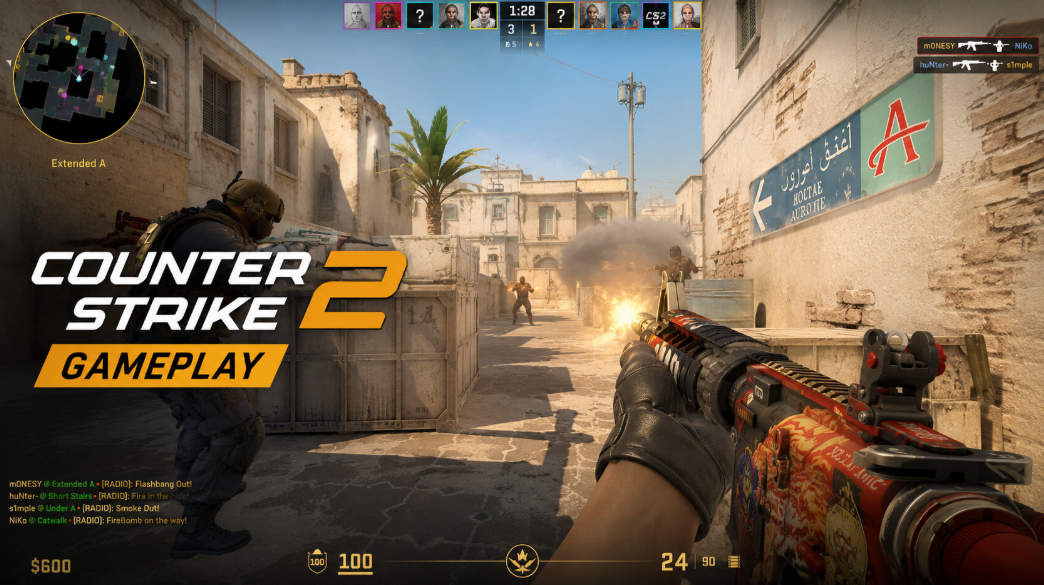
Fire a weapon in Counter-Strike 2 and you notice it instantly: the recoil feels sharper, the smoke curls around corners like real gas, and the server just seems to know where you were standing a split second ago. That’s not marketing talk. It’s the result of Valve rebuilding the entire game on a new engine instead of just patching the old one.
If you played Counter-Strike: Global Offensive for years, CS2 will feel familiar at first glance but different in almost every mechanical detail underneath. This guide breaks down how counter-strike 2 gameplay actually works today, what’s changed recently, and what to expect if you’re jumping in for the first time or coming back after a break.
What Is Counter-Strike 2, In Simple Terms?
Counter-Strike 2 is a free-to-play tactical shooter from Valve, built on the Source 2 engine. Two five-person teams Terrorists and Counter-Terrorists fight over objectives like planting or defusing a bomb, usually across best-of-24 or best-of-30 rounds. There’s no respawning mid-round, so every death matters. That single rule is what makes CS different from most shooters: a game isn’t about racking up kills, it’s about surviving to complete an objective.




The core loop hasn’t changed since the original Counter-Strike launched in 2000. What has changed is how precisely that loop is simulated.
The Engine Change That Rewrote the Rulebook
CS2 moved from the original Source engine to Source 2, and this is the single biggest reason gameplay feels different.
Sub-Tick Server Architecture
Old CS:GO servers processed player actions in fixed “ticks” usually 64 or 128 times per second. If you clicked to shoot between ticks, the server rounded your action to the nearest one, which occasionally cost you a shot that should have landed.
CS2 uses sub-tick registration, meaning the server records the exact moment you pressed a key or clicked your mouse, not just the nearest tick. Shots, jumps, and stops now register at the precise millisecond they happened. This is a genuine competitive improvement, not just a marketing buzzword — it removes a layer of randomness that pro players complained about for years.
Smarter Smoke and Environmental Interaction
Smoke grenades in CS2 are volumetric — they fill 3D space, react to gunfire (a bullet punches a temporary hole through smoke), and now interact directly with fire from molotovs and incendiaries, burning the smoke away in that area. This changes utility strategy meaningfully: you can’t just throw a smoke and assume it blocks vision forever if the enemy has fire to burn through it.
Improved Lighting and Sound
Source 2 also brought dynamic lighting and more realistic sound propagation. Footsteps, gunfire, and grenade sounds now travel and reflect more accurately through map geometry, which rewards players who play with good headphones and sound awareness.
Core Gameplay Systems in CS2
Game Modes
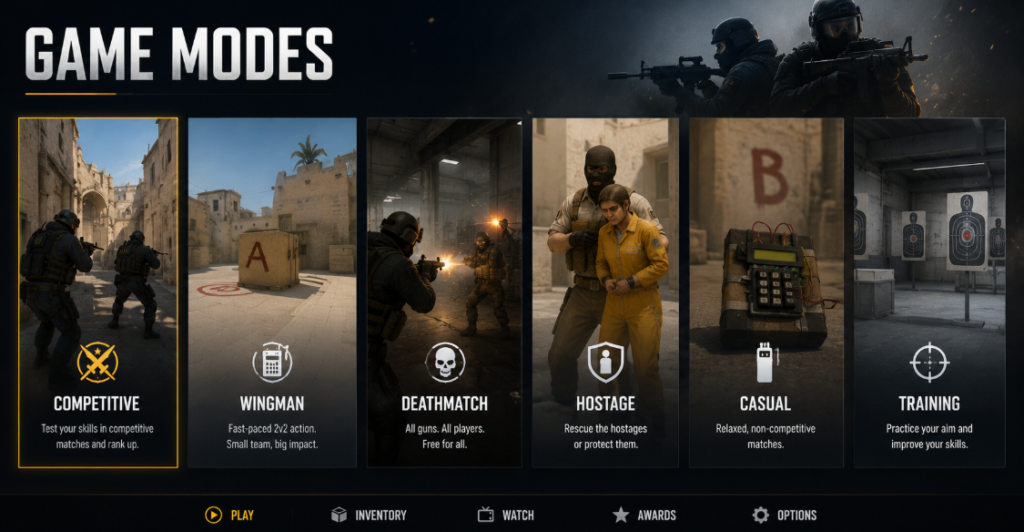
| Mode | Format | Best For |
|---|---|---|
| Competitive | 5v5, best-of-24, ranked | Serious ranked play |
| Premier | 5v5, map veto system, ranked | Players who want a CS:GO Matchmaking-style experience with map picks |
| Wingman | 2v2, best-of-16 | Quick, high-skill duels |
| Casual | 10-player, relaxed rules | Warming up, low pressure |
| Deathmatch | Free-for-all respawn mode | Practicing aim and gunplay |
| Danger Zone | Battle royale style | Something completely different |
The Buy Menu and Economy
Money management is still central to counter-strike 2 gameplay. Winning rounds, planting bombs, and getting kills earns cash; losing rounds gives a “loss bonus” that increases with consecutive losses. Teams have to decide each round whether to “buy” full gear, “force-buy” partial gear, or “eco” and save money a decision that shapes almost every round at higher skill levels.
Movement and Gunplay Basics
- Counter-strafing — tapping the opposite movement key briefly stops your character faster, which is essential for accurate shooting.
- Spray control — most weapons have a fixed recoil pattern; learning it lets you land more shots during sustained fire.
- Peeker’s advantage — the player moving into an angle typically sees the stationary player slightly before being seen, thanks to how sub-tick timing works.
None of these mechanics are new to CS2, but the sub-tick system has made them noticeably more consistent and learnable.
Recent Updates Worth Knowing About
Valve updates CS2 frequently, and some of the recent changes genuinely affect how matches play out:
- Map rotation refresh — Valve rotated several maps out of active competitive and casual pools (including Warden, Stronghold, Alpine, and Sanctum) and brought in Boulder, Fachwerk, and Shelter, while Debris and El Dorado were added to Wingman.
- Bomb-planting audio cue — the bomb’s damage health preview now shows up as soon as the bomb becomes audible, giving defenders a clearer signal during retakes.
- Smoke-fire interaction — as mentioned above, this changes how aggressively you can push through smoke if you’re carrying fire utility.
- Ongoing map polish — older competitive maps like Cache continue receiving small fixes (clipping, sound, visual clutter) rather than full overhauls.
Because Valve ships updates on a rolling basis, it’s worth checking the official Counter-Strike 2 update notes on Steam before a big tournament or ranked grind, since small changes to grenade behavior or map geometry can shift established strategies.
ALSO READ: GTA VI Awards Every Trophy Won Before Its 2026 Launch
Competitive Scene Context
Counter-Strike 2’s esports scene remains active and well-funded, with Valve-sponsored Majors continuing to be the most prestigious events in the game. Recent Majors have featured large international prize pools and drawn top-tier organizations from Europe, North America, and beyond, which keeps the meta evolving as pro strategies filter down into public matchmaking.
Is CS2 Beginner-Friendly?
Honestly, no shooter in this genre hides its learning curve, and CS2 doesn’t either. But a few things help newcomers get up to speed faster than in CS:GO:
- Deathmatch mode is a low-pressure way to build raw aim without objective pressure.
- Casual mode relaxes some competitive rules (like friendly fire) while still teaching map layouts.
- In-game tutorials and workshop maps cover basic movement, recoil control, and grenade lineups.
- Premier mode’s rank display gives a numeric skill rating so you can track improvement over time.
A realistic expectation: most players need 50–100 hours before mechanics like counter-strafing and spray control feel automatic. That’s not a flaw — it’s the reason the game has stayed relevant for over two decades.
Should You Play Counter-Strike 2 Right Now?
If you enjoy tactical shooters that reward patience, communication, and precise aim over fast respawns and streaks, CS2 remains one of the most polished options available, and it’s free. The engine upgrade genuinely improved shot registration and visual clarity compared to CS:GO, and Valve’s update cadence shows the game is still being actively developed rather than left on autopilot.
That said, it’s not for everyone. The one-life-per-round format can feel punishing if you’re used to respawn shooters, and the skill ceiling is famously steep. If tactical pacing sounds appealing, it’s worth trying Deathmatch and Casual modes first before jumping into ranked play.
Key Takeaways
- CS2 runs on Source 2 with sub-tick registration, giving more precise shot and movement timing than CS:GO.
- Smoke grenades are volumetric and now interact with fire from molotovs and incendiaries.
- The map pool changes periodically — check current rotation before ranked play.
- Economy management (buying, eco rounds, force-buys) is still central to strategy.
- Deathmatch and Casual modes are the easiest entry points for new players.
- Valve continues active, frequent updates, so mechanics can shift over time.
FAQs
Is Counter-Strike 2 free to play?
Yes. CS2 is free-to-play on Steam for Windows and Linux. You can access most game modes without spending money, though cosmetic items and some marketplace features involve real money.
What’s the biggest gameplay difference between CS2 and CS:GO?
The sub-tick server architecture is the biggest change it registers your actions at the exact moment they happen instead of rounding to the nearest server tick, making shooting and movement feel more precise.
Do I need a powerful PC to run CS2 well?
CS2 can run on modest hardware, but Source 2’s improved lighting and effects mean older GPUs may need lower settings for smooth frame rates. Valve’s official system requirements are the best reference point before installing.
How long does it take to get good at CS2?
There’s no fixed number, but most players report needing 50–100+ hours before core mechanics like counter-strafing and recoil control start feeling natural. Improvement continues well beyond that with map knowledge and game sense.
Does Valve still update CS2 regularly?
Yes. Valve ships updates covering gameplay tweaks, map rotations, bug fixes, and cosmetic additions on an ongoing basis, so it’s worth checking official patch notes periodically.
Can I play Counter-Strike 2 with friends casually, not competitively?
Yes. Casual and Deathmatch modes are designed for lower-pressure play, and private lobbies let you set up matches with friends outside of ranked matchmaking.
For more updates visit: GAME TYPES












Comments 1