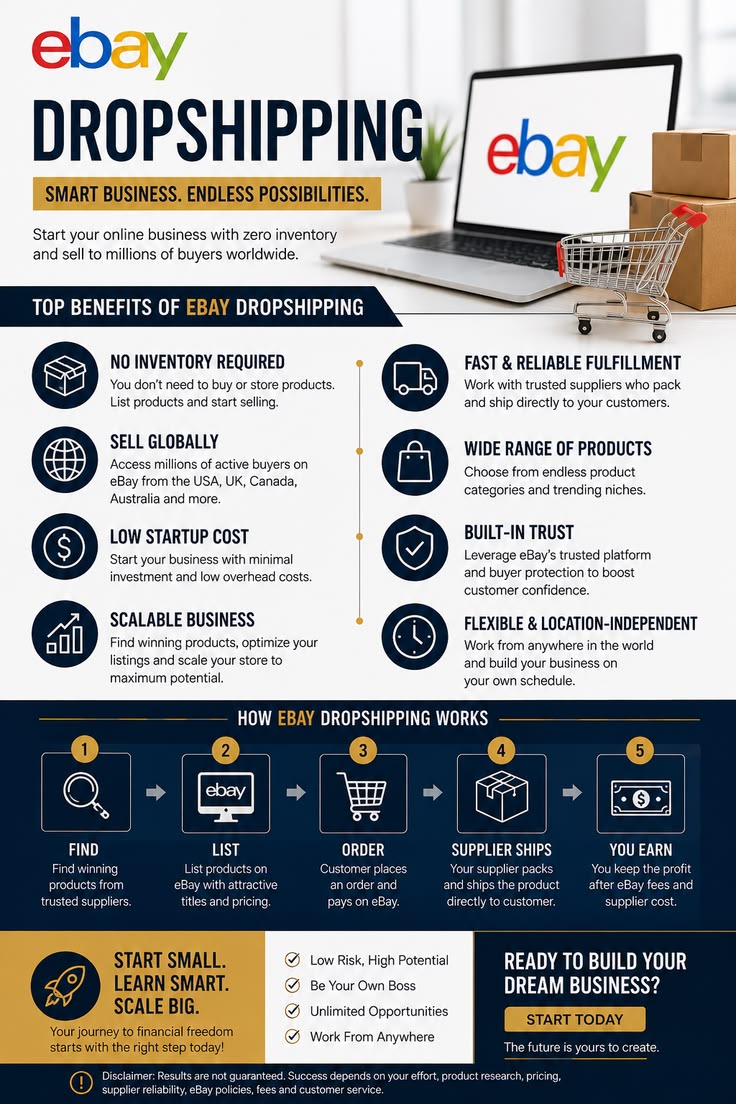
The dropshipping business model has become a popular way to start an online business without purchasing large quantities of inventory or managing a physical warehouse. Instead of storing products, entrepreneurs partner with suppliers who handle inventory, packaging, and delivery directly to customers.
This approach allows online store owners to focus on product selection, digital marketing, customer acquisition, and building their brands. Platforms such as Shopify and WooCommerce have made it easier for beginners to create online stores and integrate supplier fulfillment services.
However, dropshipping is not an automatic source of passive income. Success depends on choosing profitable products, working with reliable suppliers, controlling advertising expenses, and maintaining customer satisfaction.

Whether you are exploring online entrepreneurship or planning to launch an ecommerce store, understanding how dropshipping works is essential. This guide explains the entire business model, its advantages and disadvantages, startup costs, earning potential, and practical strategies for building a sustainable dropshipping business in 2026.
What Is the Dropshipping Business Model?
The dropshipping business model is an ecommerce fulfillment method in which an online retailer sells products without keeping them in physical inventory.
When a customer purchases an item, the retailer sends the order information to a third-party supplier. The supplier then prepares, packages, and ships the product directly to the customer.
The retailer earns revenue from the sale and pays the supplier for the product and fulfillment services.
For example, an online store might sell a phone accessory for $30 while purchasing it from a supplier for $12. The $18 difference represents the initial gross spread before shipping, advertising, transaction fees, refunds, and other business expenses.
Unlike traditional retailers, dropshipping businesses generally do not need to invest heavily in bulk inventory before making their first sale.
Shopify describes dropshipping as a method that allows retailers to sell products while outsourcing inventory storage and delivery to suppliers.

Dropshipping
+1
How Does the Dropshipping Business Model Work?
Dropshipping involves three primary participants: the customer, the online retailer, and the supplier.
Each participant plays a different role in completing an order.
Dropshipping Order Flow
CustomerPlaces and pays for an order
Your Online StoreReceives order and pays supplier
SupplierPacks and ships the product
Product delivered directly to customer
1. The Customer Places an Order
A customer visits your ecommerce website, selects a product, and completes the checkout process.
The customer pays the retail price displayed on your store.
2. The Retailer Receives the Payment
Your online store records the purchase and sends an order confirmation to the customer.
You are responsible for managing the customer relationship, providing accurate product descriptions, and responding to questions.
3. The Order Is Forwarded to the Supplier
After receiving the order, you purchase the product from your chosen supplier.
This process can be completed manually or automatically through integrated dropshipping software.
4. The Supplier Packages and Ships the Product
The supplier picks the item from its inventory, prepares the package, and arranges shipment to the customer’s address.
The retailer usually does not physically handle the product.
5. The Customer Receives the Product
The customer receives the purchased item, while the online retailer remains responsible for customer support, order issues, and applicable return or refund obligations.
According to Amazon’s dropshipping guidance, fulfillment outsourcing reduces inventory responsibilities but can limit control over packaging, shipping speed, and product quality.

Sell on Amazon
Dropshipping Business Model Example
Consider an entrepreneur who launches an online store specializing in home organization products.
The store sells a compact storage organizer sourced from a supplier.
The financial breakdown for one order might look like this:
| Expense or Revenue | Amount |
|---|---|
| Customer selling price | $40 |
| Supplier product cost | $15 |
| Shipping cost | $5 |
| Advertising expense | $8 |
| Payment processing fee | $2 |
| Profit before other overhead and taxes | $10 |
In this example, the retailer earns $10 on the transaction after the listed variable expenses.
The profit margin is 25% of the selling price before considering additional costs such as subscriptions, customer returns, taxes, and other business overhead.
Actual results can differ significantly depending on supplier pricing, customer acquisition costs, shipping arrangements, and product demand.
Types of Dropshipping Business Models
Dropshipping is not limited to reselling generic products from international marketplaces. Entrepreneurs can choose different approaches depending on their budget, target audience, and business goals.
Product Reselling Dropshipping
This is the most common type of dropshipping.
Retailers source existing products from manufacturers or wholesalers and list them on their own ecommerce stores.
The retailer focuses on creating attractive listings, building customer trust, and generating sales.
Print-on-Demand Dropshipping
Print-on-demand allows entrepreneurs to sell customized products without manufacturing or storing inventory.
Popular products include:
- T-shirts
- Hoodies
- Coffee mugs
- Phone cases
- Posters
- Tote bags
Products are printed and shipped after customers place orders.
This approach is especially attractive to artists, designers, influencers, and content creators.
Niche Dropshipping
Niche dropshipping focuses on products designed for a specific audience or interest.
Examples include pet accessories, gardening tools, gaming desk accessories, and home fitness equipment.
A specialized store can develop stronger positioning than a general store selling unrelated products.
Branded Dropshipping
Branded dropshipping involves working with suppliers that support customized packaging, product presentation, or private-label arrangements.
This allows businesses to create a recognizable identity while outsourcing fulfillment.
However, some branding options require minimum order quantities or additional fees.
Business Extension Dropshipping
In this model, an online seller partners with an existing retailer or business to offer its products through another sales channel.
The original business fulfills orders while the online partner manages marketing and customer acquisition.
Shopify also identifies product reselling, business extensions, product creation, and print-on-demand as distinct dropshipping approaches.
Types of dropshipping
Advantages of the Dropshipping Business Model
Dropshipping offers several potential benefits compared with traditional inventory-based retail.
Low Initial Investment
One of the biggest advantages is that entrepreneurs usually do not need to purchase large amounts of inventory upfront.
Instead, capital can be directed toward website development, marketing, supplier testing, and customer service.
No Warehouse Required
Suppliers handle product storage and fulfillment, reducing the need for physical warehouse space.
This can lower operating expenses and simplify daily logistics.
Flexible Product Selection
Retailers can experiment with multiple product categories without purchasing bulk stock for every item.
Products that perform poorly can be removed from the store, although advertising and testing expenses may still be lost.
Location Independence
A dropshipping business can often be managed remotely, provided the owner has reliable internet access, supplier communication, and suitable payment services.
Easier Product Testing
Entrepreneurs can evaluate customer interest before investing in a large inventory order.
This flexibility is particularly useful when exploring new niches.
Potential for Scalability
Order management software and supplier integrations can automate routine fulfillment tasks.
However, scaling still requires effective marketing, financial management, supplier reliability, and customer support.
Disadvantages of the Dropshipping Business Model
Although dropshipping reduces some operational responsibilities, it introduces other challenges.
Lower Profit Margins
Highly competitive products often have limited pricing flexibility.
Advertising expenses, shipping charges, transaction fees, and refunds can reduce earnings significantly.
Strong Competition
Many retailers may sell identical products from the same suppliers.
Without clear differentiation, businesses can struggle to compete on anything other than price.
Limited Quality Control
Since suppliers handle products directly, retailers may have limited control over manufacturing quality, packaging, and order accuracy.
Shipping Delays
Delivery times depend on supplier processing, warehouse location, shipping methods, and customs procedures.
International orders may take considerably longer than domestic shipments.
Inventory Availability Problems
A supplier may run out of stock without providing immediate updates.
This can lead to canceled orders, delays, and unhappy customers.
Customer Service Responsibilities
Even though suppliers fulfill orders, the retailer generally remains responsible for communicating with customers and resolving problems.
Dependence on Third-Party Suppliers
Supplier mistakes can damage your brand reputation.
Choosing reliable partners and establishing clear agreements is therefore essential.
Dropshipping vs Traditional Ecommerce
Both dropshipping and traditional ecommerce involve selling products online, but they differ in inventory ownership and fulfillment responsibilities.
| Feature | Dropshipping | Traditional Ecommerce |
|---|---|---|
| Inventory ownership | Usually held by supplier | Usually held by retailer |
| Upfront inventory cost | Generally low | Often higher |
| Product storage | Supplier manages | Retailer or warehouse manages |
| Shipping | Supplier fulfills | Retailer or fulfillment partner |
| Quality control | More limited | Often greater |
| Branding flexibility | Supplier dependent | Generally greater |
| Product margins | Often pressured by competition | Potentially higher |
| Inventory risk | Lower | Higher |
| Startup complexity | Relatively accessible | Depends on operation |
| Supplier dependence | High | Varies |
Neither model guarantees profitability.
Dropshipping may be suitable for entrepreneurs testing new products, while traditional inventory ownership can offer greater control over fulfillment and product presentation.
How to Start a Dropshipping Business in 2026
Building a dropshipping store requires planning beyond simply selecting products and creating a website.
Choose a Profitable Niche
Begin by identifying a specific group of customers and the types of products they need.
Potential niches include home accessories, pet care products, office organization, and travel accessories.
Evaluate market demand, product competition, pricing flexibility, and customer buying behavior.
Research Products and Market Demand
Use keyword research, marketplace data, search trends, and competitor analysis to understand what customers are looking for.
Avoid choosing products based only on viral social media videos.
A product should solve a genuine problem, offer clear value, or appeal strongly to a defined audience.
Find Reliable Dropshipping Suppliers
A reliable supplier should offer consistent product quality, clear delivery estimates, reasonable pricing, and responsive communication.
Common sourcing options include AliExpress, CJdropshipping, specialized wholesalers, and print-on-demand suppliers.
Availability and service quality vary by product and destination country.
Before committing, order samples and evaluate actual product quality and shipping performance.
Create Your Online Store
Popular ecommerce platforms include Shopify and WooCommerce.
Your website should include professional product pages, clear navigation, secure checkout, customer contact information, and accurate shipping and return policies.
Set Competitive Product Prices
Calculate product cost, shipping fees, transaction charges, marketing expenses, taxes, and expected return costs.
Pricing should support sustainable profitability instead of focusing only on generating sales.
Develop a Marketing Strategy
Dropshipping businesses commonly attract customers through SEO, social media marketing, paid advertising, influencer partnerships, and email marketing.
A combination of organic and paid channels can reduce dependence on a single traffic source.
Test Products Before Scaling
Begin with a manageable number of products.
Monitor conversion rates, customer acquisition costs, refund rates, delivery performance, and actual profit per order.
Expand only when there is sufficient evidence of consistent demand and workable margins.
How Much Does It Cost to Start Dropshipping?
Dropshipping typically requires less upfront inventory capital than traditional retail, but operating expenses still exist.
The following table provides an illustrative beginner budget in US dollars.
| Startup Expense | Example Budget |
|---|---|
| Domain name | $10–$25 per year |
| Ecommerce platform or hosting | $15–$50 per month |
| Website theme or design | $0–$150 |
| Product samples | $30–$150 |
| Marketing tests | $100–$500 |
| Apps and integrations | $0–$100 per month |
| Illustrative initial budget | $155–$925 |
These are planning estimates rather than live provider quotes. Costs vary with the platform, supplier, location, and marketing strategy.
It is possible to begin with a smaller budget, but very limited marketing and testing funds can make it difficult to evaluate products properly.
Is Dropshipping Profitable in 2026?
Dropshipping can be profitable in 2026, but profitability depends on effective execution rather than the fulfillment method alone.
Retailers must generate enough revenue to cover their product costs, fulfillment charges, marketing expenses, platform fees, returns, and taxes.
For example, consider an ecommerce store generating $10,000 in monthly revenue.
Illustrative Monthly Dropshipping Profit
Monthly revenue
$10,000
Operating profit before taxes
$1,500
Products and shipping
$5,500 · 55%
Advertising
$2,500 · 25%
Fees and other costs
$500 · 5%
Profit
$1,500 · 15%
Hypothetical example only, not an industry average or earnings guarantee.
In this scenario, the business earns $1,500 before taxes, representing a 15% operating profit margin.
However, a business with poor advertising performance or excessive refunds could lose money despite generating substantial sales.
Revenue should never be confused with profit.
Best Products for Dropshipping in 2026
The best products depend on customer demand, supplier reliability, competition, and available profit margins.
Several product categories are worth researching.
Home Organization Products
Storage organizers, cable management accessories, drawer dividers, and space-saving household products can address practical consumer needs.
Pet Accessories
Pet grooming tools, travel accessories, feeding mats, and interactive toys are potential products for stores targeting pet owners.
Fitness Accessories
Resistance bands, exercise accessories, workout storage solutions, and gym-related items may appeal to fitness enthusiasts.
Office and Desk Accessories
Desk organizers, laptop stands, cable holders, and workspace accessories can attract students and remote workers.
Travel Accessories
Packing organizers, luggage tags, toiletry bags, and travel pouches are potential products for travel-focused stores.
Personalized Gifts
Print-on-demand mugs, custom posters, and personalized apparel allow retailers to differentiate their offerings.
Product suitability should be validated through research and supplier testing rather than assuming that any category is guaranteed to sell.
Best Ecommerce Platforms for Dropshipping
The right platform depends on technical experience, available integrations, budget, and sales channels.
| Platform | Main Advantage | Suitable For |
|---|---|---|
| Shopify | Hosted ecommerce environment | Beginners and growing stores |
| WooCommerce | WordPress flexibility and control | WordPress users |
| BigCommerce | Built-in ecommerce capabilities | Growing online businesses |
| Wix | User-friendly website builder | Small stores |
| eBay | Existing marketplace audience | Sellers meeting marketplace policies |
| Amazon | Large ecommerce marketplace | Eligible sellers following its dropshipping rules |
Marketplace policies are important. For example, Amazon permits dropshipping under specific conditions, including requirements about being identified as the seller of record and handling customer returns appropriately.
Sell on Amazon
How to Market a Dropshipping Store Successfully
Marketing is one of the most important responsibilities of a dropshipping retailer.
A well-designed website alone will not guarantee visitors or sales.
Search Engine Optimization (SEO)
SEO helps potential customers find your products through search engines.
A strong ecommerce SEO strategy includes keyword research, optimized product titles, unique product descriptions, internal linking, fast-loading pages, and useful informational content.
Publishing buying guides, product comparisons, and tutorials can also attract customers during the research stage.
Social Media Marketing
Platforms such as Instagram, TikTok, Pinterest, and Facebook can help businesses demonstrate products and engage potential customers.
Video demonstrations and authentic customer content may be particularly useful for visual products.
Paid Advertising
Google Ads and social media advertising can generate traffic more quickly than organic strategies.
However, advertising should be tested carefully because high acquisition costs can eliminate profit margins.
Influencer Marketing
Collaborating with relevant creators can help introduce products to an established audience.
Focus on audience relevance and engagement quality rather than follower counts alone.
Email Marketing
Email can support abandoned checkout recovery, customer retention, and repeat purchases.
Messages should provide useful offers and follow applicable consent and marketing requirements.
Common Dropshipping Mistakes to Avoid
Beginners frequently encounter preventable problems when launching an online store.
Selling highly saturated products: Competing with numerous identical stores can make customer acquisition expensive.
Ignoring supplier quality: Poor products and unreliable delivery damage customer trust.
Depending entirely on paid ads: A store without organic traffic or customer retention may struggle when advertising costs increase.
Using misleading product descriptions: Exaggerated claims can increase complaints, refunds, and legal risks.
Failing to calculate true profit: Supplier prices alone do not represent the full cost of each sale.
Ignoring shipping and refund policies: Customers need clear information about delivery expectations and their rights.
Scaling without validated demand: Increasing advertising spending before understanding profitability can multiply losses.
Is Dropshipping Legal?
Dropshipping is generally a legitimate retail fulfillment method, but businesses must comply with the laws and regulations of the jurisdictions where they operate and sell.
Requirements may involve business registration, taxation, consumer protection, product safety, advertising standards, intellectual property, and privacy.
Retailers are also responsible for setting accurate customer expectations and complying with applicable shipping and refund requirements.
Cross-border transactions may introduce customs duties, import restrictions, VAT obligations, or additional consumer protection rules.
The exact requirements depend on the seller’s location, customer location, product category, and marketplace.
Future of the Dropshipping Business Model
The dropshipping industry continues to evolve as ecommerce technology and customer expectations change.
Automation tools can simplify product imports, inventory synchronization, fulfillment updates, and some customer service workflows.
Artificial intelligence can support product research, content development, data analysis, and marketing experimentation, although its recommendations still require verification.
Other important business trends include growing interest in branded products, faster fulfillment options, personalized shopping experiences, and stronger customer retention strategies.
Businesses that compete only by copying generic product listings may struggle to differentiate themselves.
In contrast, retailers that build trustworthy brands, create valuable content, and maintain reliable supplier relationships may be better positioned for long-term growth.
Frequently Asked Questions
What Is the Dropshipping Business Model in Simple Words?
Dropshipping is an online selling method where a retailer sells products without storing them. After receiving an order, the retailer purchases the item from a supplier who ships it directly to the customer.
Can Beginners Start a Dropshipping Business?
Yes. Beginners can start dropshipping with a suitable ecommerce platform and supplier. However, they need to learn product research, pricing, digital marketing, and customer support.
Do You Need Money to Start Dropshipping?
Most businesses require some starting capital for a website, product samples, payment processing, marketing, and related expenses. Dropshipping reduces inventory costs but does not eliminate financial risk.
Is Dropshipping Better Than Traditional Ecommerce?
Dropshipping offers lower upfront inventory requirements and simpler fulfillment, while traditional ecommerce generally provides greater control over stock, packaging, and delivery. The better option depends on business goals.
How Do Dropshippers Make Money?
Dropshippers earn money when revenue from product sales exceeds supplier costs, shipping, marketing, payment fees, returns, and other operating expenses.
Can You Start Dropshipping Without a Website?
Some entrepreneurs sell through marketplaces or social commerce channels without operating independent websites. However, they must follow each platform’s policies and applicable business requirements.
Is Dropshipping Passive Income?
Not entirely. Although order fulfillment can be automated, product research, advertising, customer service, supplier management, and financial monitoring usually require ongoing work.
What Is the Biggest Risk in Dropshipping?
Major risks include unreliable suppliers, high advertising costs, low profit margins, shipping delays, and customer dissatisfaction. The most serious risk varies by business.
How Long Does It Take to Become Profitable With Dropshipping?
There is no guaranteed timeline. Some businesses find profitable products relatively quickly, while others require months of testing or never reach profitability.
Can Dropshipping Become a Full-Time Business?
Yes. A dropshipping store can become a full-time business if it consistently generates enough profit to cover operating expenses and the owner’s financial needs.
Conclusion
The dropshipping business model provides an accessible way to enter ecommerce without managing large inventories or operating a warehouse. Its main advantages include lower upfront stock costs, flexible product selection, and outsourced fulfillment.
However, sustainable success requires more than launching a website. Entrepreneurs need dependable suppliers, effective marketing, realistic pricing, and strong customer service.
By researching demand carefully, testing products, monitoring profitability, and building customer trust, a dropshipping business can develop into a sustainable ecommerce operation in 2026 and beyond.