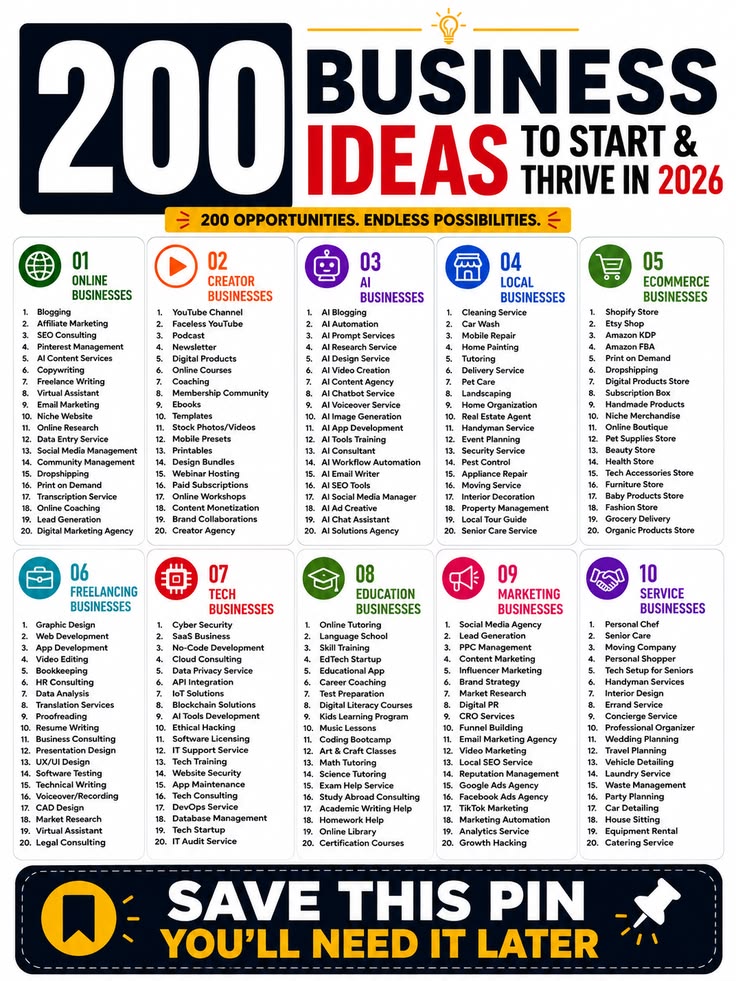
Starting a small business in 2026 offers opportunities for people who want financial independence, flexible working hours, or an additional source of income. With digital tools, online marketplaces, artificial intelligence, and growing demand for specialized services, entrepreneurs can launch many businesses without investing in expensive offices or large inventories.
However, choosing the right business requires more than following popular trends. A successful idea should match your skills, available budget, target customers, and local market demand.
Some entrepreneurs prefer online businesses such as digital marketing, freelancing, and e-commerce. Others find opportunities in home cleaning, tutoring, pet care, food services, or mobile car detailing.
This guide explores 30 small business ideas for 2026, their estimated startup costs, potential advantages, challenges, and practical steps for getting started.
Best Small Business Ideas for 2026 at a Glance
The following table compares business opportunities based on typical lean startup budgets and operating models.
| Small Business Idea | Estimated Startup Cost (USD) | Business Type |
|---|---|---|
| Freelance Writing | $0–$300 | Online |
| Social Media Management | $100–$500 | Online |
| Print-on-Demand Store | $100–$500 | Online |
| Virtual Assistant Services | $0–$300 | Remote |
| Online Tutoring | $0–$300 | Online |
| Dropshipping | $200–$1,000 | E-commerce |
| Digital Marketing Agency | $200–$1,500 | Online |
| AI Automation Services | $100–$1,000 | Technology |
| Graphic Design | $100–$1,000 | Creative |
| Blogging | $100–$500 | Online |
| Affiliate Marketing | $100–$500 | Online |
| Handmade Products | $100–$1,000 | Home-Based |
| Home Cleaning Service | $200–$1,500 | Local Service |
| Pet Sitting | $100–$500 | Local Service |
| Mobile Car Detailing | $500–$3,000 | Local Service |
These figures are illustrative planning estimates for small-scale launches, not verified market averages or guaranteed budgets. Actual costs depend on location, equipment already owned, licensing, insurance, marketing, and operating requirements.
Why Start a Small Business in 2026?
Small businesses continue to benefit from technological developments and changing consumer expectations.
Digital platforms make it easier to reach customers, manage payments, advertise services, and operate remotely. Entrepreneurs can also use automation tools to reduce repetitive administrative work.
Artificial intelligence is becoming particularly relevant. The U.S. Chamber of Commerce’s October 2026 technology report found that 66% of surveyed U.S. small businesses were using AI, compared with 58% in 2025. This illustrates how quickly digital tools are becoming part of everyday business operations.
Several developments are influencing new business opportunities:
- Growing adoption of AI-assisted business tools.
- Demand for convenient local and home-based services.
- Expansion of online shopping and social commerce.
- Interest in flexible education and professional training.
- Opportunities for specialized freelance services.
- Greater availability of affordable digital business software.
Nevertheless, growing demand does not guarantee profitability. Competition, customer acquisition costs, and operating expenses still determine whether a business can succeed.
30 Profitable Small Business Ideas to Start in 2026
1. Start a Digital Marketing Agency
Digital marketing remains a practical business opportunity for people experienced in helping companies attract and convert customers online.
A small agency can specialize in search engine optimization, paid advertising, email marketing, or social media campaigns.
Estimated startup cost: $200–$1,500.
Potential services include SEO audits, local search optimization, advertising management, website content planning, and lead generation.
Beginners can start with one specialized service rather than attempting to provide every marketing solution. For example, an agency focusing exclusively on local SEO for dentists or home-service businesses may find it easier to communicate its value to prospective clients.
The biggest challenge is demonstrating measurable results and retaining customers.
2. Launch an AI Automation Business
Businesses increasingly use AI tools to improve productivity and streamline operations. This creates opportunities for entrepreneurs who can implement reliable, useful automation systems.
An AI automation service might help clients organize customer inquiries, route leads, prepare reports, schedule appointments, or connect existing software.
Estimated startup cost: $100–$1,000.
Entrepreneurs should develop practical skills in workflow design, integrations, data protection, and quality assurance.
The most valuable offering is not simply access to AI technology. It is a well-tested solution that saves customers time or reduces unnecessary work.
Always obtain permission before handling confidential customer information, and include human review where mistakes could have significant consequences.
3. Start a Print-on-Demand Business
Print-on-demand allows entrepreneurs to sell customized products without purchasing large quantities of inventory in advance.
Common products include T-shirts, mugs, tote bags, posters, notebooks, and phone cases.
Estimated startup cost: $100–$500.
A supplier generally produces and ships an item after a customer orders it. This lowers inventory risk, although production, shipping, refunds, and advertising can significantly reduce margins.
Successful stores often focus on a particular audience, such as hobby enthusiasts, teachers, or sports fans.
Original designs and careful product-quality checks are essential. Sellers must also respect copyrights and trademarks.
4. Offer Social Media Management Services
Many businesses need help maintaining active social media accounts but cannot justify hiring a full-time employee.
A social media manager can create posting schedules, produce short videos, write captions, monitor engagement, and prepare performance reports.
Estimated startup cost: $100–$500.
Potential clients include restaurants, salons, boutiques, fitness instructors, and professional service providers.
Beginners should create sample content and offer a clearly defined monthly package.
Over time, they can expand into content strategy, paid advertising, or community management.
5. Become a Virtual Assistant
Virtual assistant services are suitable for organized individuals with strong communication and administrative skills.
Businesses may outsource email organization, calendar management, customer support, data entry, research, and document preparation.
Estimated startup cost: $0–$300, assuming a suitable computer and internet connection are already available.
Virtual assistants can work with individual entrepreneurs or multiple businesses.
Specializing in services such as e-commerce administration or executive assistance can help differentiate an offering from general data-entry services.
6. Start an Online Tutoring Business
Online tutoring allows knowledgeable individuals to teach students without operating a physical classroom.
Popular areas include mathematics, science, English, programming, exam preparation, and professional skills.
Estimated startup cost: $0–$300.
Tutors can provide individual lessons, small-group classes, recorded learning resources, or structured learning programs.
Building trust requires subject expertise, clear explanations, and realistic learning objectives.
Tutors working with children should also follow appropriate safeguarding and privacy practices.
7. Launch a Dropshipping Store
Dropshipping is an e-commerce business model in which an external supplier fulfills customer orders.
Sellers manage product selection, storefront operations, marketing, and customer service without necessarily stocking the products themselves.
Estimated startup cost: $200–$1,000.
Although the model may require less inventory investment than traditional retail, it carries risks involving product quality, supplier reliability, shipping delays, advertising costs, and returns.
Entrepreneurs should order samples, verify suppliers, and calculate their complete cost per sale before launching.
Dropshipping is not automatically a passive-income business.
8. Start a Freelance Writing Business
Freelance writing is an accessible option for people who can produce useful, accurate, engaging content.
Potential services include technical documentation, website copy, newsletters, product descriptions, case studies, and specialized articles.
Estimated startup cost: $0–$300.
Clients increasingly value subject expertise, originality, fact-checking, and editorial judgment.
Writers can improve their competitiveness by specializing in industries such as technology, finance, education, or business software.
A portfolio containing several high-quality examples is often more useful than offering every type of writing service.
9. Start a Graphic Design Business
Graphic design services are needed by businesses developing brand identities, advertising campaigns, websites, and product packaging.
Estimated startup cost: $100–$1,000.
Possible services include logo development, presentation design, marketing materials, social media graphics, and packaging layouts.
Beginners can build a portfolio of original projects before approaching clients.
AI-assisted design tools can improve production efficiency, but professional designers still need to understand typography, visual hierarchy, brand consistency, and licensing.
10. Create a Blogging Business
Blogging can become a digital publishing business built around useful content for a clearly defined audience.
Potential niches include personal finance education, gardening, travel planning, technology tutorials, hobbies, and home improvement.
Estimated startup cost: $100–$500.
Possible revenue sources include advertising, affiliate commissions, sponsorships, digital products, and direct services.
However, blogging is usually a long-term project. Search traffic can fluctuate, and income may remain limited while a website develops its audience.
Original expertise, reliable information, and a clear editorial focus are more sustainable than publishing large quantities of generic content.
11. Start an Affiliate Marketing Business
Affiliate marketing involves recommending products or services and earning commissions when qualifying actions or purchases occur.
Entrepreneurs may publish reviews, comparisons, educational videos, or buying guides.
Estimated startup cost: $100–$500.
Affiliate businesses need an audience and a credible reason for readers or viewers to trust their recommendations.
Clear disclosures, accurate product information, and genuine testing where possible help build that trust.
Commission rates and program rules vary, so projected earnings should not be treated as guaranteed.
12. Sell Digital Products
Digital products can be sold repeatedly without physical packaging or inventory.
Examples include spreadsheets, business templates, printable planners, digital illustrations, study materials, and educational resources.
Estimated startup cost: $50–$500.
A useful digital product should solve a specific problem.
For example, a freelancer could sell an invoice-tracking spreadsheet, while a teacher might create classroom planning resources.
The primary challenges involve product