


You landed your first combo, but your friend just called it a “meaty tick throw into a punish.” You nodded like you understood. You didn’t.
That’s the moment every new fighting game player hits. The community has its own language, and nobody hands you a dictionary when you start. This fighting game glossary fixes that. It breaks down the terms you’ll actually hear in ranked matches, YouTube guides, and Discord servers explained in plain English, not jargon-on-jargon.
Whether you’re picking up Street Fighter 6, Tekken 8, Guilty Gear, or any other title, the vocabulary below is largely shared across the genre. Learn it once, and you’ll understand almost any fighting game community.




Why a Fighting Game Glossary Actually Matters
Fighting games reward precise communication. When a coach says “that’s a -3 move, don’t press buttons after it,” they’re giving you real, actionable advice. If you don’t know what “-3” means, that advice is wasted.
Knowing the terminology also helps you:
- Understand match commentary and tournament streams
- Follow tutorials without pausing every ten seconds to Google a word
- Talk to teammates and training partners without confusion
- Read patch notes and character frame data with confidence
This isn’t about sounding smart. It’s about actually improving faster, because most high-level advice online assumes you already know these words.
Core Fighting Game Terms Everyone Should Know
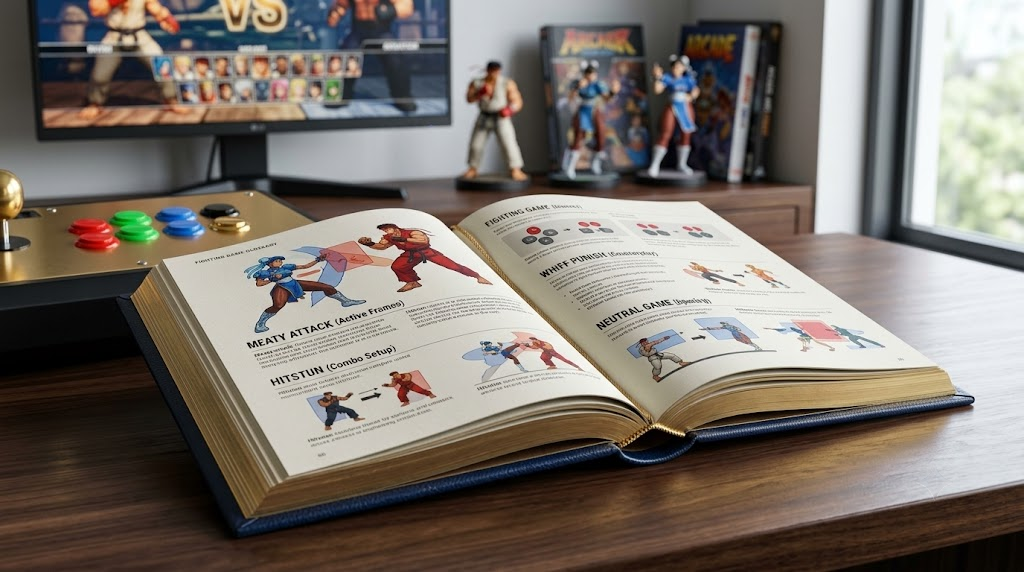
Frame Data
A “frame” is a single unit of animation time, usually 1/60th of a second. Frame data tells you how fast a move starts up, how long it’s active, and how long you’re vulnerable afterward. Players who understand frame data can predict what’s safe to do and what will get punished.
Hitbox and Hurtbox
- Hitbox: the invisible area around an attack that can hit the opponent.
- Hurtbox: the area on your character that can be hit.
If an opponent’s hitbox touches your hurtbox, you get hit. Some moves have small hitboxes but huge hurtboxes, making them risky despite looking safe.
Combo
A combo is a sequence of attacks that the opponent cannot block or escape once the first hit lands. Combos are the reward for landing a hit — the better your combo, the more damage or advantage you get.
Punish
A punish is an attack you land specifically because the opponent left themselves open, usually after a blocked or whiffed move. “Punishing” is one of the most important skills in any fighting game.
Whiff
When an attack is thrown out but doesn’t hit anything — either it missed or the opponent blocked without contact — that’s a whiff. Whiffing a slow move is often heavily punished.
Zoning
Zoning is a playstyle focused on keeping the opponent at a distance using projectiles, long-range normals, or space control, rather than rushing in.
Rushdown
The opposite of zoning. Rushdown players close the gap quickly and pressure the opponent with constant offense, giving them little room to breathe.
Footsies
Footsies describes the neutral, mid-range poking game where both players try to land a hit-confirm or bait a whiff without fully committing. It’s often considered the heart of fighting game skill.
Neutral
“Neutral” refers to the state of the match when neither player has the advantage — no one is being pressured or cornered. Winning neutral usually means landing the first meaningful hit.
Offense and Defense Terms Explained
| Term | Meaning |
|---|---|
| Block String | A sequence of attacks designed to keep the opponent blocking with no gaps to escape through |
| Mix-up | Alternating between different attack options (high/low, left/right) to confuse the opponent’s guess |
| Meaty | An attack timed to hit the opponent the instant they wake up or become vulnerable |
| Tech (Throw Tech) | An input that breaks an opponent’s grab attempt |
| Wakeup | The moment a knocked-down character stands back up, often a vulnerable window |
| Okizeme (Oki) | Offensive pressure applied specifically during an opponent’s wakeup |
| Option Select (OS) | An input that covers two or more possible opponent reactions with a single decision |
| Cross-up | An attack that hits from the opposite side of where it visually appears to come from, confusing block direction |
These terms often overlap in real matches. A strong player might set up a meaty cross-up as part of their okizeme, then follow with a mix-up block string. Once you know each piece, the whole sentence makes sense.
Also Read: Inside Game Walkthrough Complete Guide to Every Chapter
Movement and Execution Terms
Dash and Backdash
A dash moves your character quickly forward; a backdash moves backward, often with temporary invulnerability in many games, making it a useful defensive tool.
Anti-Air
Any move used specifically to stop an opponent’s jump-in attack before it lands. Reliable anti-airs are essential in almost every fighting game.
DP (Dragon Punch)
Named after Street Fighter’s Shoryuken input, “DP” refers to any fast, rising anti-air special move, even in games without an actual dragon punch motion.
Cancel
Canceling means interrupting one move’s animation early by inputting another action, usually to link attacks into combos or make unsafe moves safer.
Super/EX Move
Special attacks that consume a resource bar (often called meter). “Supers” are usually the strongest attacks in the game, while “EX moves” are enhanced versions of regular specials that cost partial meter.
A Quick Comparison: Common Playstyle Terms
| Playstyle | Focus | Typical Tools |
|---|---|---|
| Zoning | Distance control | Projectiles, long normals |
| Rushdown | Constant pressure | Fast normals, mix-ups |
| Grappler | Command grabs | High damage throws, armor moves |
| Footsies-based | Neutral dominance | Pokes, spacing, whiff punishes |
No single style is objectively best — most top players blend elements of all four depending on the matchup.
Conclusion
Fighting game terminology can feel overwhelming at first, but almost every term exists to describe something you’ve already seen happen in a match — you just didn’t have the word for it yet. Once you understand frame data, punishes, zoning, and mix-ups, tutorials and match commentary start making a lot more sense.
Keep this glossary handy while you watch tournaments or study your own matches. The vocabulary will click faster once you connect each word to something you’ve actually experienced in-game.
FAQs
What does “frame trap” mean in fighting games?
A frame trap is a sequence of two attacks with a small gap between them, timed so that if the opponent tries to attack in that gap, they get hit first instead.
What is “meter” in a fighting game?
Meter is a resource bar built by attacking, blocking, or taking damage, which is then spent on special moves, combo extensions, or defensive options like guard cancels.
What does “plus on block” mean?
It means the attacker recovers from their move faster than the defender recovers from blocking, so the attacker gets to act first — often letting them continue pressure safely.
What is a “tier list” in fighting games?
A tier list ranks characters from strongest to weakest based on competitive results, tools, and matchup strength, though rankings change as players discover new strategies.
What does “SDI” mean?
SDI stands for Smart Directional Influence, a mechanic in some games (notably Guilty Gear titles) that lets the defender nudge their character’s position slightly during hitstun to escape certain combos.
Do all fighting games use the same terminology?
Most core terms — combo, punish, zoning, frame data — are shared across the genre, though some games add their own specific mechanics and slang on top.
For more updates visit: GAME TYPES











Comments 2